

Summary
A practical guide to AI security readiness in Saudi Arabia: the NCA draft AI Cybersecurity Guidelines (AICG-1:2026), breach costs in the Kingdom, the ten guidelines that need new engineering, control mapping, a 20-point checklist and a 90-day plan.
Saudi organisations are putting generative AI and agents into customer service, software delivery and operations. Security has not kept pace. In July 2026, the National Cybersecurity Authority (NCA) published a draft of what it expects: the AI Cybersecurity Guidelines (AICG-1:2026), with 42 guidelines across four domains.
This guide turns that draft into something you can act on: the threat picture, the business case, the structure of the guidelines, the controls and evidence behind each one, a self-assessment and a 90-day plan you can start on Monday.
Key takeaways
| # | Takeaway | What it means for you |
| 1 | The risk is already priced in | The average breach in the Kingdom costs SAR 27M. Public-facing applications, including AI chat and APIs, are the costliest way in at SAR 34.7M. |
| 2 | October 2026 changed the clock | PHP2Shell was exploited about five hours after its details leaked and over six hours before the fix shipped. |
| 3 | The expectation is written down | The NCA draft sets 42 guidelines across 4 domains, names generative and agentic AI in scope and reuses the ECC structure. |
| 4 | DevSecOps is the cheapest fix | IBM links a DevSecOps approach, EDR and encryption to the lowest breach costs in Saudi Arabia. |
Who this guide is for
• CISOs and security leaders who need a defensible AI security roadmap and board-level numbers.
• AppSec, DevSecOps and cloud security engineers who will build the controls.
• AI and platform teams shipping LLM features, RAG systems or agents.
• GRC and compliance teams mapping ECC, NCNICC and PDPL obligations to AI.
What’s inside
1. The October 2026 vulnerability storm
2. What the numbers say about AI and vulnerabilities
3. What a breach costs in Saudi Arabia
4. AI in the attack, and the defence
5. The regulatory picture and the structure of AICG-1:2026
6. Anatomy of an AI system: seven components, seven ways in
7. Ten guidelines that need new engineering, and control mapping
8. The 20-point readiness checklist
9. Scoring and the 90-day plan, common mistakes, and how we help
10. FAQ
1. October 2026: the vulnerability storm
One month taught one lesson: attackers now move in hours. In 31 days, defenders faced a record Patch Tuesday, firewall zero-days, a PHP flaw exploited before its fix, and a wave of bugs in AI agents and gateways.
PHP2Shell, hour by hour
On 21 October, two memory bugs in PHP itself (CVE-2026-109618 and CVE-2026-109619, CVSS 9.2) exposed every server running PHP 5.4 or later to unauthenticated remote code execution.
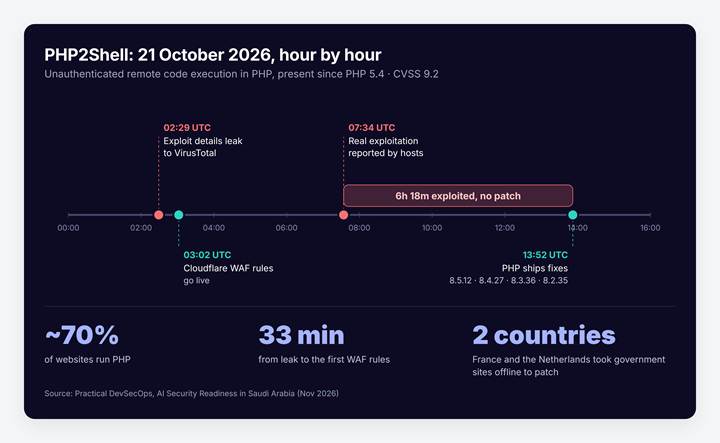
Three things stand out:
• Exploitation started about five hours after the leak, and more than six hours before a fix existed.
• The fastest defence was a WAF rule, live 33 minutes after the leak. Patching took over eleven hours.
• The impact was national. Roughly 70% of websites run PHP, and France and the Netherlands took government sites offline to patch.
The rest of the month
| Date | Incident | What happened | Reference |
| 2 Oct | AWS Loom agent platform | Full admin to any network client when no identity provider was set | CVE-2026-103956 |
| 13 Oct | Microsoft Patch Tuesday | Record 1,411 flaws; Windows Shell MotW bypass exploited as a zero-day | CVE-2026-96951 |
| 16 Oct | Claude Agent SDK | Crafted session ID injects an MCP server and runs commands past permissions | CVE-2026-96620 |
| 19 Oct | Envoy AI Gateway and Agent Mesh | Any OIDC token holder could self-enrol and call every MCP tool | CVE-2026-103091 |
| 21 Oct | LiteLLM and agentic intrusions | Malware slipped into LiteLLM release packages; CrowdStrike reports four actors using AI agents in intrusions | Supply chain |
| 21 Oct | PHP2Shell | Unauthenticated RCE in PHP, exploited before the patch | CVSS 9.2 |
| 28 Oct | Cisco ASA and FTD firewalls | Zero-day exploited to crash SSL VPN devices | CVE-2026-76418 |
| 30 Oct | TAKO AI Agent for Okta | Unauthenticated first-run admin takeover of an AI agent | CVSS 9.8 |
Five of those eight incidents hit AI software directly: agent platforms, agent SDKs, AI gateways and an AI library’s release packages.
2. AI found the bugs. Attackers moved faster.
Disclosures have doubled, and AI-credited finds are up more than 20 times. Exploitation grew far more slowly. What really changed is speed, and AI software itself has become a target.
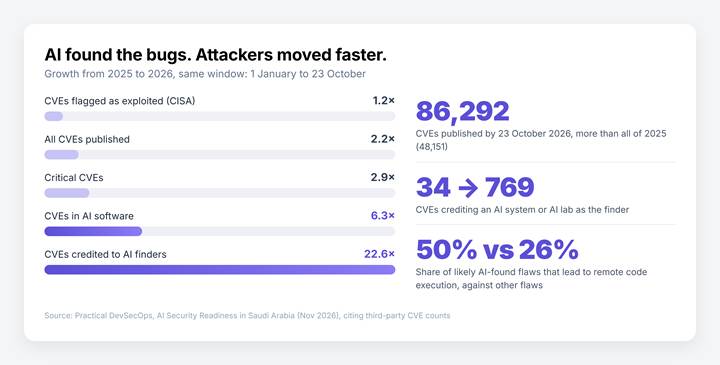
| Metric (1 Jan to 23 Oct) | 2025 to 2026 change |
| CVEs flagged as exploited (CISA) | 1.2× |
| All CVEs published | 2.2×, reaching 86,292 (all of 2025: 48,151) |
| Critical CVEs | 2.9× |
| CVEs in AI software | 6.3× |
| CVEs credited to AI finders | 22.6×, from 34 to 769 |
| Share of flaws leading to remote code execution | 50% for likely AI-found flaws vs 26% for others |
What it means for an AI estate in the Kingdom
| Priority | Draft guideline | Action |
| Know what you run | AICG 2-1 | 3,191 CVEs hit AI software this year, and half sit in agent orchestration tools. Build an AI inventory first. |
| Patch at machine speed | AICG 2-6-3 | Keep a kill switch for vulnerable AI features and a WAF rule path that ships in minutes. |
| Guard the gateway | AICG 2-2 | An AI gateway holds every provider key behind it. Vault the keys, scope the tokens, rate-limit. |
3. What a breach costs in Saudi Arabia
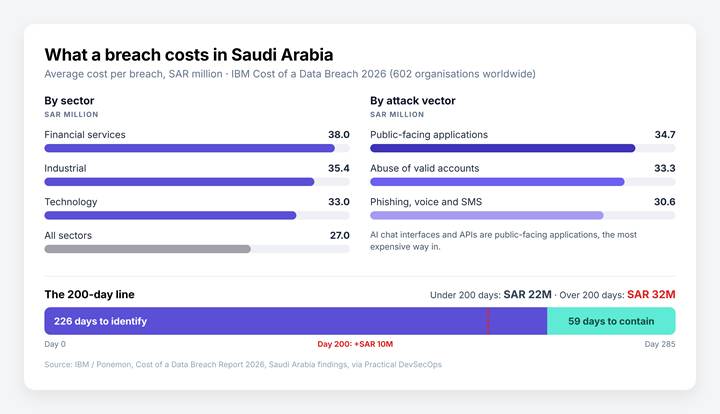
IBM and the Ponemon Institute studied 602 breached organisations worldwide, including Saudi Arabia, for incidents between March 2025 and February 2026 (Cost of a Data Breach Report 2026).
Key figures
• SAR 27M average cost per breach across all sectors.
• SAR 38M in financial services, the most expensive sector, followed by industrial (SAR 35.4M) and technology (SAR 33M).
• SAR 34.7M when the attack starts at a public-facing application, the costliest vector. AI chat interfaces and APIs fall into this category.
• 226 days to identify, 59 days to contain: a breach lifecycle of 285 days.
• SAR 10M penalty for slowness: breaches with a lifecycle under 200 days averaged SAR 22M; those over 200 days, SAR 32M.
What moves the cost
| Cuts the cost | Raises the cost |
| 1. A DevSecOps approach | 1. Mismanaged secrets and keys |
| 2. Endpoint detection and response | 2. Missing security skills |
| 3. Encryption of sensitive data | 3. Poor threat prioritisation |
Only 37% of breached Saudi organisations encrypted sensitive data at rest and in transit. That’s one of the cheapest gaps to close.
4. AI in the attack, and the defence
Attackers use AI to move faster. Defenders who use AI and automation well spend far less per breach. And every AI system you deploy is a new asset to protect.
AI is already in Saudi breaches
• 25% of malicious breaches in Saudi Arabia used AI. Across the Middle East the figure is 26%, with another 11% unsure.
• 55% of regional organisations with a SOC already run AI agents inside it.
• 16% of regional breaches began in the supply chain, at USD 8.45M each.
The automation dividend
| Use of security AI and automation | Average breach cost in the Kingdom |
| Extensive use | SAR 23.15M |
| No use | SAR 32.08M |
| Difference | SAR 8.9M saved |
Yet 25% of Saudi organisations use no security AI or automation at all.
Why this matters for AI systems specifically
Agents run on service accounts, API keys and tokens. The region’s number one cost driver, mismanaged secrets and keys, is exactly the control agents depend on.
Teams in the region secure these non-human identities mainly through:
• A machine identity inventory (57% of organisations).
• Extending zero trust to AI-driven processes (43%).
In practice, that means every agent needs:
• Its own identity, never a shared human account.
• Least-privilege permissions scoped to the tools it actually uses.
• Short-lived tokens and secrets held in a vault, never in prompts, code or config files.
• Logging of every tool call, so the SOC can see what the agent did and on whose behalf.
5. The regulatory picture
The AI guidelines apply requirements the NCA already sets elsewhere to AI systems. A working ECC programme can be extended rather than rebuilt.
The road to AI regulation
| When | Milestone | What it means |
| 2024 | ECC-2:2024 | 108 essential controls: your baseline |
| 2025 | NCNICC-1:2025 | Controls for the non-CNI private sector |
| Early 2026 | PDPL enforcement | SDAIA enforces the personal data protection law |
| 5 Jul 2026 | AICG-1:2026 draft | AI guidelines open for public consultation |
| 5 Aug 2026 | Consultation closes | The draft moves to finalisation |
| Next | Final guidelines | Publication pending as of November 2026 |
How the frameworks stack
Each layer builds on the one below it:
1. PDPL at the base: personal data obligations underneath everything.
2. ECC-2:2024 and NCNICC-1:2025 in the middle: the 108 baseline controls.
3. AICG-1:2026 on top: AI-specific guidance.
Why act on a draft?
The draft calls the guidelines recommended, not mandatory. Four reasons to start anyway:
• It restates NCA requirements you may already be measured on.
• PDPL enforcement already targets weak technical security in AI data flows.
• Clients and regulators will ask AI security questions shaped by this text.
• Controls built now become evidence later.
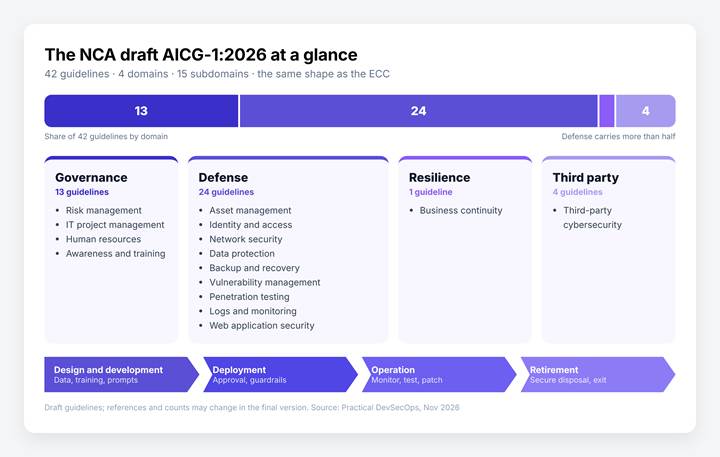
Inside AICG-1:2026: 42 guidelines on one page
| Domain | Guidelines | Subdomains |
| 1. Governance | 13 | Risk management · IT project management · Human resources · Awareness and training |
| 2. Defense | 24 | Asset management · Identity and access · Network security · Data protection · Backup and recovery · Vulnerability management · Penetration testing · Logs and monitoring · Web application security |
| 3. Resilience | 1 | Business continuity |
| 4. Third party | 4 | Third-party cybersecurity |
| Total | 42 | 15 subdomains |
The draft covers the whole AI lifecycle:
• Design and development: data, training, prompts.
• Deployment: approval, guardrails.
• Operation: monitoring, testing, patching.
• Retirement: secure disposal and exit.
6. Anatomy of an AI system: seven components, seven ways in
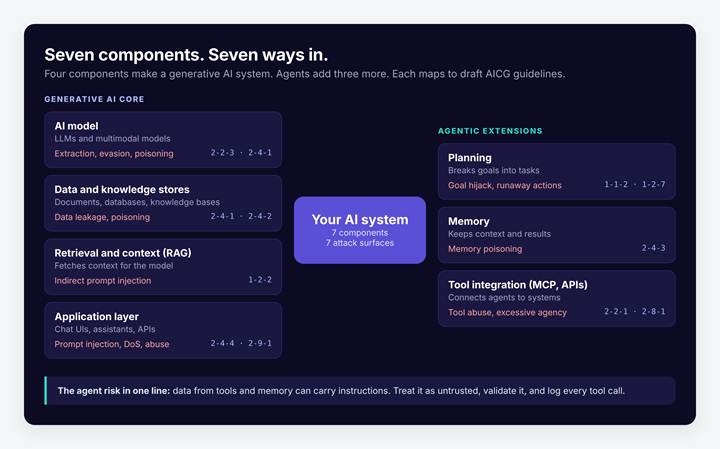
Four components make a generative AI system. Agents add three more that let it plan and act. Each component maps to specific draft guidelines.
| Component | What it does | Main threats | Draft guidelines |
| AI model | LLMs and multimodal models | Extraction, evasion, poisoning | 2-2-3, 2-4-1 |
| Data and knowledge stores | Documents, databases, knowledge bases | Data leakage, poisoning | 2-4-1, 2-4-2 |
| Retrieval and context (RAG) | Fetches context for the model | Indirect prompt injection | 1-2-2 |
| Application layer | Chat UIs, assistants, APIs | Prompt injection, DoS, abuse | 2-4-4, 2-9-1 |
| Planning (agentic) | Breaks goals into tasks | Goal hijack, runaway actions | 1-1-2, 1-2-7 |
| Memory (agentic) | Keeps context and results | Memory poisoning | 2-4-3 |
| Tool integration (MCP, APIs) (agentic) | Connects agents to systems | Tool abuse, excessive agency | 2-2-1, 2-8-1 |
October 2026, mapped to the components
| Date | AI agent CVE | What happened | Component |
| 8 Oct | Pydantic AI web chat | Any website the developer visits can run the agent and its approval-gated tools | Application layer |
| 16 Oct | Claude Agent SDK | Crafted session ID injects an MCP server and bypasses permissions | Tool integration |
| 19 Oct | Envoy AI Gateway | Any OIDC token holder can call every MCP tool | Identity and tools |
| 30 Oct | TAKO AI Agent for Okta | First-run admin takeover, CVSS 9.8 | Application layer |
The agent risk in one line
Data from tools and memory can carry instructions. Treat it as untrusted, validate it, and log every tool call. October’s Claude Agent SDK, Envoy AI Gateway and TAKO agent CVEs all sit on this boundary.
What that looks like in practice:
• Validate and sanitise everything entering the context window from tools, memory, RAG and third-party APIs.
• Keep tool permissions per agent, not per platform, and require approval for high-impact actions.
• Protect agent memory from unauthorised writes, and check stored content for poisoning.
• Send every tool call and AI-initiated action to the SOC.
7. Ten guidelines that need new engineering
Most guidelines extend controls you already run. These ten need new designs, tests or pipeline gates. They take the longest, so start here.
| # | Guideline | Draft ref | What to do | Type of work |
| 1 | Score agent actions by impact | 1-1-2 | Classify what each agent can do by impact, likelihood and reversibility; match safeguards to the score | New design |
| 2 | Treat tool and memory data as untrusted | 1-2-2 | Validate anything entering the context window from tools, memory or third-party APIs | New design |
| 3 | No uncontrolled learning in production | 1-2-3 | Don’t retrain live models unless the risk is assessed and controls are in place | New pipeline gate |
| 4 | Review AI-generated code | 1-2-5 | Security review, testing and approval before AI-written code reaches any environment | New pipeline gate |
| 5 | Graduated autonomy | 1-2-7 | Grow agent independence step by step, with human oversight of security decisions | New design |
| 6 | Rate limits against extraction | 2-2-3 | Usage thresholds and rate limits to reduce model extraction and data leakage | New pipeline gate |
| 7 | Protect agent memory | 2-4-3 | Block unauthorised changes to memory and validate stored content against poisoning | New design |
| 8 | Tested guardrails | 2-4-4 | Detect malicious input, unauthorised actions and disclosure; test before go-live and after changes | New test |
| 9 | Red team and prove the override | 2-7-2 | Adversarial evaluation and red teaming, plus proof that human override works | New test |
| 10 | Safe shutdown and rollback | 3-1-1 | Rollback, safe shutdown and manual alternatives during an incident | New test |
From guideline to control and evidence
For each subdomain: the controls that satisfy it, the evidence an auditor will ask for, and the related OWASP Top 10 for LLM Applications (2025) risks.
D1: Cybersecurity governance
| Subdomain | What to implement | Evidence | OWASP LLM |
| 1-1 Risk management | AI risk register per use case; agent action catalogue scored by impact, likelihood and reversibility; threat model per AI system | Risk register, threat models, action matrix | LLM06 |
| 1-2 IT project management | Security gates in the AI pipeline; context validation for RAG, tools and memory; AI-generated code scanned and reviewed; approval for high-impact AI | Pipeline configs, gate results, approvals | LLM01, LLM05 |
| 1-3 Human resources | Vetting for privileged AI access; acceptable use and confidentiality covering prompts and outputs | Signed policies, vetting records | LLM02 |
| 1-4 Awareness and training | Role-based AI security training for builders; safe prompting awareness for all staff | Training plan, completion data | LLM02 |
D2: Cybersecurity defense
| Subdomain | What to implement | Evidence | OWASP LLM |
| 2-1 Asset management | Inventory of models, datasets, vector stores, prompts, agents, MCP servers and AI vendors, with owners | AI asset inventory, AI-BOM | LLM03 |
| 2-2 Identity and access | Least-privilege agent roles; short-lived tokens; vaulted secrets; rate limits and quotas at the gateway | Role matrix, access reviews, gateway policy | LLM06, LLM10 |
| 2-3 Network security | Segment AI components; egress allow-lists for model, tool and retrieval traffic | Network diagrams, egress rules | LLM06 |
| 2-4 Data protection | Encrypt prompts, embeddings, weights, logs and outputs; classify data before it enters a model; memory integrity checks; input, output and action guardrails | Encryption settings, guardrail tests | LLM02, LLM04, LLM08 |
| 2-5 Backup and recovery | Versioned backups of models, prompts, configs and vector stores; tested restore and rollback | Backup policy, restore logs | LLM04 |
| 2-6 Vulnerability management | Scan model files, libraries and containers; track AI advisories; kill switch for vulnerable features | Scan reports, advisory log | LLM03 |
| 2-7 Penetration testing | AI pen test before go-live and periodically; red teaming; human override drills | Pen test and red team reports | LLM01, LLM07 |
| 2-8 Logs and monitoring | Log prompt config changes, dataset access, tool calls and AI-initiated actions; AI detections in the SOC | SIEM use cases, retention | LLM06 |
| 2-9 Web application security | TLS, rate limiting, DoS protection, controlled egress and unsafe-channel filters for AI apps and APIs | WAF and API gateway config | LLM10 |
D3 and D4: Resilience and third party
| Subdomain | What to implement | Evidence | OWASP LLM |
| 3-1 Business continuity | Rollback, safe shutdown and manual fallback per AI system; AI scenarios in BCM and DR tests | Runbooks, DR test results | LLM06 |
| 4-1 Third party | Review AI vendors, models and plugins before use and on a schedule; contract clauses for AI security, exit and disposal | Vendor assessments, contracts | LLM03 |
8. The 20-point readiness checklist
A self-assessment you can finish in 15 minutes. Answer for your most important AI system: Yes = 2, Partly = 1, No = 0.
D1: Governance (6 questions)
| # | Question | Draft ref |
| 01 | AI security risks are assessed across the full lifecycle, from design to retirement. | 1-1-1 |
| 02 | Agent actions are classified by impact and reversibility, with safeguards for high-impact actions. | 1-1-2 |
| 03 | Data from tools, memory, RAG and third-party APIs is treated as untrusted and validated. | 1-2-2 |
| 04 | AI-generated code is security reviewed and tested before use. | 1-2-5 |
| 05 | High-impact AI needs a formal security approval before production. | 1-2-6 |
| 06 | Teams that build or operate AI get role-based AI security training. | 1-4-1 |
D2: Defense (10 questions)
| # | Question | Draft ref |
| 07 | We keep an inventory of all AI components with owners and lifecycle status. | 2-1-1/2 |
| 08 | AI agents and service accounts have least-privilege, role-based access. | 2-2-1 |
| 09 | Tokens, keys and AI service accounts are reviewed on a fixed schedule. | 2-2-2 |
| 10 | Rate limits and usage thresholds protect against extraction and data leakage. | 2-2-3 |
| 11 | AI components are segmented and egress is limited to approved destinations. | 2-3-1 |
| 12 | Prompts, embeddings, weights, logs and outputs are encrypted and access-restricted. | 2-4-1 |
| 13 | Guardrails are tested before release and after every material change. | 2-4-4 |
| 14 | AI systems are pen tested and red-teamed before go-live and periodically. | 2-7-1/2 |
| 15 | Prompt config changes, tool calls and AI-initiated actions are logged and monitored. | 2-8-1/2 |
| 16 | Vulnerable AI features can be disabled quickly until a fix is validated. | 2-6-3 |
D3: Resilience (2 questions)
| # | Question | Draft ref |
| 17 | Each AI system has a defined rollback, safe shutdown and manual fallback. | 3-1-1 |
| 18 | Backup, recovery and rollback for AI systems are tested periodically. | 2-5-2 |
D4: Third party (2 questions)
| # | Question | Draft ref |
| 19 | AI vendors, third-party models and plugins are assessed before use and monitored. | 4-1-2 |
| 20 | Contracts set AI security duties, exit, portability and secure disposal terms. | 4-1-3/4 |
Add up your total out of 40, then read your result in the next section.
Tips for an honest score
• Score the system as it runs today, not as the design document describes it.
• “Partly” means the control exists for some components or some of the time. If you can’t show evidence, score it “No”.
• Ask the engineers who operate the system, not only the people who approved it.
9. Read your score, then run 90 days
What your score means
| Score | Band | Where to focus first |
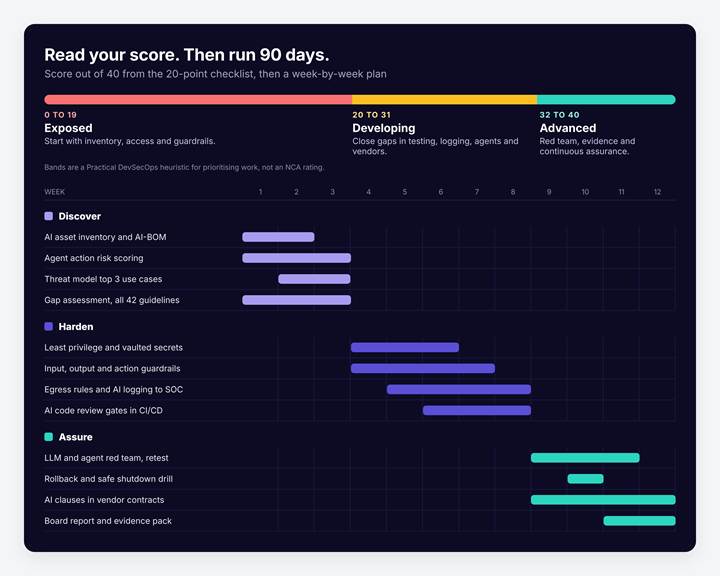
| 0 to 19 | Exposed | Start with inventory, access and guardrails |
| 20 to 31 | Developing | Close gaps in testing, logging, agents and vendors |
| 32 to 40 | Advanced | Red team, evidence and continuous assurance |
Bands are a Practical DevSecOps heuristic for prioritising work, not an NCA rating.
The 90-day plan, week by week
| Phase | Workstream | Weeks |
| Discover | AI asset inventory and AI-BOM | 1 to 2 |
| Agent action risk scoring | 1 to 3 | |
| Threat model the top 3 use cases | 2 to 3 | |
| Gap assessment against all 42 guidelines | 1 to 3 | |
| Harden | Least privilege and vaulted secrets | 4 to 6 |
| Input, output and action guardrails | 4 to 7 | |
| Egress rules and AI logging to the SOC | 5 to 8 | |
| AI code review gates in CI/CD | 6 to 8 | |
| Assure | LLM and agent red team, then retest | 9 to 11 |
| Rollback and safe shutdown drill | 10 | |
| AI clauses in vendor contracts | 9 to 12 | |
| Board report and evidence pack | 11 to 12 |
How to adapt the plan to your band
• Exposed: don’t skip Discover. Without an inventory, every later step guesses at scope. Prioritise vaulted secrets and least privilege for agents, since mismanaged keys are the region’s top cost driver.
• Developing: compress Discover into two weeks and spend the extra time on guardrail testing and AI logging in the SOC.
• Advanced: run Discover as a refresh, then move straight to red teaming, override drills and a repeatable evidence pack for regulators and clients.
Build it into the pipeline
IBM’s data links a DevSecOps approach to the lowest breach costs in the Kingdom. The same logic applies to AI. Controls such as AI code review gates, model file scanning, guardrail tests and egress policies are cheapest when they run automatically on every release, and every run produces evidence you can show an auditor.
10. Seven common mistakes to avoid
These are the patterns that most often slow AI security programmes down, or leave gaps that an auditor or attacker finds first.
| # | Mistake | Why it hurts | Do this instead |
| 1 | Waiting for the final guidelines | Controls take months to build, and October showed attacks land in hours | Start with the ten engineering guidelines now; they’re unlikely to disappear |
| 2 | Treating AI as a separate programme | Duplicates governance and evidence you already produce for the ECC | Extend your ECC controls, risk register and SIEM to AI components |
| 3 | Shared keys for agents | Mismanaged secrets are the region’s top breach cost driver | One identity per agent, vaulted secrets, short-lived tokens |
| 4 | Trusting retrieved and tool data | Indirect prompt injection rides in through documents, email and APIs | Validate everything entering the context window (AICG 1-2-2) |
| 5 | Guardrails tested once | Model, prompt and tool changes silently break them | Retest after every material change (AICG 2-4-4) |
| 6 | No kill switch | A vulnerable AI feature stays live while you wait for a vendor | Feature flags and WAF rules that ship in minutes (AICG 2-6-3) |
| 7 | Override never drilled | Nobody knows if a human can actually stop the agent mid-task | Run override and safe shutdown drills (AICG 2-7-2, 3-1-1) |
11. How Practical DevSecOps can help
The Practical DevSecOps Consulting Team runs fixed-scope, fixed-timeline engagements that end with evidence you can show a regulator, a client or your board.
| Engagement | Duration | What you get |
| AI Security Readiness Assessment (best starting point) | 3 to 4 weeks | Gap report against all 42 draft guidelines · AI asset inventory and risk register · Prioritised 90-day remediation plan |
| LLM and Agent Red Team | 2 to 3 weeks | Prompt injection, tool abuse and MCP testing · Data leakage and model extraction checks · Human override validation and retest |
| Secure AI SDLC | 6 to 8 weeks | Guardrails and AI code review in CI/CD · Agent identity, secrets and egress controls · AI detections and logging for the SOC |
| Agentic AI Threat Modelling | 2 weeks per use case | Component and data flow mapping · Agent action risk scoring · Controls mapped to AICG and OWASP |
How an engagement runs
1. Scoping call (30 minutes): agree systems, goals and timeline.
2. Assess: hands-on testing and review against AICG-1:2026.
3. Fix with you: pair with your engineers on the priority gaps.
4. Evidence pack: report, retest results and audit-ready evidence.
Bring your checklist score and your top AI use cases to a free 30-minute call, and leave with your gaps and the first steps to close them.
Build the skills before the final text lands
Every step in this guide depends on engineers who can threat model an AI system, run a prompt injection, abuse an over-permissioned agent, and build guardrails that hold.
The Certified AI Security Professional (CAISP) course from Practical DevSecOps teaches exactly that, in browser-based labs:
• The OWASP Top 10 for LLM Applications, with hands-on prompt injection and data leakage labs.
• MITRE ATLAS and STRIDE threat modelling for AI systems.
• AI supply chain security: model scanning, signing, SLSA and MLBOMs.
• AI governance under the NIST AI RMF, ISO/IEC 42001 and the EU AI Act.
• No prior AI or ML experience needed. It ends with a 6-hour practical exam.
Start your 7-day free trial and run your first AI security lab today.
 Certified AI Security Professional (CAISP)7-day free trial
Open a live AI security lab in your browser today
Real targets, real terminals, no local setup.
No credit card required.
Frequently Asked Questions
The NCA’s draft AI Cybersecurity Guidelines. It sets 42 guidelines across four domains (governance, defense, resilience and third party) and names generative and agentic AI in scope.
The draft calls them recommended, not mandatory. They restate NCA requirements many organisations are already measured on, and PDPL enforcement already targets weak security in AI data flows.
Consultation ran from 5 July to 5 August 2026. As of November 2026, the final version is still pending.
They reuse the ECC structure and apply existing NCA requirements to AI systems. A working ECC-2:2024 programme can be extended rather than rebuilt.
The ten that need new engineering: agent action scoring, untrusted context, no uncontrolled learning, AI code review, graduated autonomy, rate limits, agent memory protection, tested guardrails, red teaming with override proof, and safe shutdown.
Agents with too much access. They run on keys and tokens, mismanaged secrets are the region’s top breach cost driver, and October 2026’s agent CVEs all sat on the boundary between agents and their tools.
No. Most of the work is familiar security engineering (least privilege, input validation, logging, supply chain and pipeline gates) applied to new components.