

Editorial disclosure: Practical DevSecOps sells CAISP. It’s listed first because we built it and have first-hand lab data on it. For the other 5 certs, each section states the basis of our assessment.
Summary
AI security roles pay competitive salaries in 2026, but most cybersecurity professionals don’t hold the specialized skills to qualify. This guide compares 6 certifications across 4 tracks: hands-on technical (CAISP), offensive AI (SANS SEC535, SEC598), audit and compliance (ISACA AAIA), and governance (ISACA AAISM, IAPP AIGP)..
The right choice depends on what you’re doing day-to-day, not on salary ceiling alone. For engineers securing LLM pipelines and AI supply chains: CAISP. For CISOs building AI governance programs: AAISM. For red teamers with a serious budget: SANS SEC535. For privacy and legal professionals navigating EU AI Act obligations: AIGP. .
All 6 certifications are covered below with cost, exam format, prerequisites, and an honest assessment of what each delivers.
Why these 6 certifications
This list covers the certs that security practitioners and hiring managers actually discuss in the AI security space in 2026. It excludes general security certs (CISSP, CISM, Security+) because they don’t address LLM-specific attack surfaces. It excludes vendor-specific AI certifications (AWS, Google, Microsoft) because they’re environment-specific, not role-defining credentials.
Basis of each assessment:
- CAISP: Assessed from first-hand course development, lab environment data, student outcomes, and instructor knowledge. We built this cert.
- ISACA AAISM, AAIA: Assessed from public exam objectives, ISACA’s published frameworks, and community feedback. AAISM is for CISM/CISSP holders already doing AI security governance work. It’s worth it if you’re an experienced security or risk leader whose role already touches AI governance, and it’s not worth it if you’re early in your career or your work doesn’t involve AI.
AAIA is for CISA/CIA/CPA holders who audit. AAISM prepares you to build governance and manage risk across the AI lifecycle, whereas AAIA sharpens your ability to evaluate, audit, and assure AI performance and compliance.
The exam itself is scenario-heavy. Both certs require you to think in ISACA’s governance-first lens, not as a technical AI practitioner. That’s the single biggest prep mistake people make.
SANS SEC535, SEC598:
After searching Reddit, LinkedIn, G2, Trustpilot, personal security blogs, AWS Marketplace, and SANS’s own community forums, there are no independent learner reviews publicly available for either SANS SEC535 (Offensive AI: Attack Tools and Techniques) or SEC598 (AI and Security Automation for Red, Blue, and Purple Teams).
Both courses are genuinely new. SEC598 underwent a 40% content overhaul in 2025, adding GenAI, LLMs, and agentic AI throughout. SEC535’s associated certification, the GIAC GOAA, launched in 2026. Any reviews written before those changes describe a materially different course.
Security practitioners who attend SANS at 6,000–9,000 per course typically do so on employer funding, which often comes with disclosure constraints. The ones who do write about their training tend to publish 6–12 months after completing it, once they’ve actually applied the skills on the job. That window hasn’t closed yet for either course in their current form.
IAPP AIGP:
Assessed from public exam objectives and IAPP’s published candidate guide. Real practitioners who passed the IAPP AIGP confirm it covers the EU AI Act at a governance framework level, not legal practice depth. The exam tests risk classification, provider vs deployer obligations, and scenario-based governance judgment. It rewards structured thinking, not practitioner instinct. Legal and GRC professionals call it a strong foundation for AI governance, not a complete compliance toolkit.
If you’ve taken any of these certs and want to contribute a practitioner review, contact us at [[email protected]].
Quick Comparison for Top AI Security Certifications – 2026
| Certification Name | Provider | Best For (Role) | Cost | Key Focus |
| Certified AI Security Professional (CAISP) | Practical DevSecOps | DevSecOps Engineers, Red Teamers, AppSec, Software Developers, AI SOC Orchestrator, AI Offensive Orchestrator, AI/ML Security Engineer, DevOps Engineers,and an AI Security Specialist. | ~$999 | Counter LLM threats, OWASP Top 10 framework, mitigate AI supply chain risks and attacks, Apply AI threat modeling with STRIDE methods,and secure DevOps against AI-specific attacks. |
| Advanced in AI Security Management (AAISM) | ISACA | CISOs and Security Managers | ~$599+ (Training & Application Fee) | AI Governance and Program Management, AI Risk Management, and AI Technologies and Controls. |
| SEC598: AI and Security Automation for Red, Blue, and Purple Teams | SANS Institute | SOC analysts, detection engineers, automation engineers, incident responders, and security engineers. | ~$8,780 | Build automation playbooks, deploy RAG-based agents, design AI-augmented defensive playbooks. |
| SEC535: Offensive AI | SANS Institute | Penetration testers, Red Team operators, Security consultants, SoC personnel, and Security architects | ~$5,250+ | Engineer AI-powered pentesting GPTs, OSINT analysis, social engineering attacks. |
| Advanced in AI Audit (AAIA) | ISACA | IT Auditors, Compliance Officers | ~$599+ (Training & Application Fee) | AI Governance and Risk, AI Operations, and AI Auditing Tools. |
| Certified AI Governance Professional (AIGP) | IAPP | Privacy Officers, Legal Counsel | ~$799 + (Training fee) | AI laws and governance frameworks and risk management. |
The Top 6 AI Security Certifications You Should Consider in 2026
1. Certified AI Security Professional (CAISP) from Practical DevSecOps
Provider: Practical DevSecOps
Best for: AI Security Engineers, Security Engineers Red Teamers, AppSec, Software Developers, DevSecOps Engineer, AI SOC Orchestrators, AI Offensive Orchestrators, AI/ML Security Engineers, and AI Security Specialists.
Why it’s #1: Focuses heavily on “doing” rather than just theory. Counter LLM threats with the OWASP Top 10 framework and MITRE Atlas Frameworks, mitigate AI supply chain risks and attacks, apply AI threat modeling with STRIDE methods, and secure DevOps against AI-specific attacks.
Key Skill: Hands-on labs for securing GenAI pipelines.
Cost considerations:
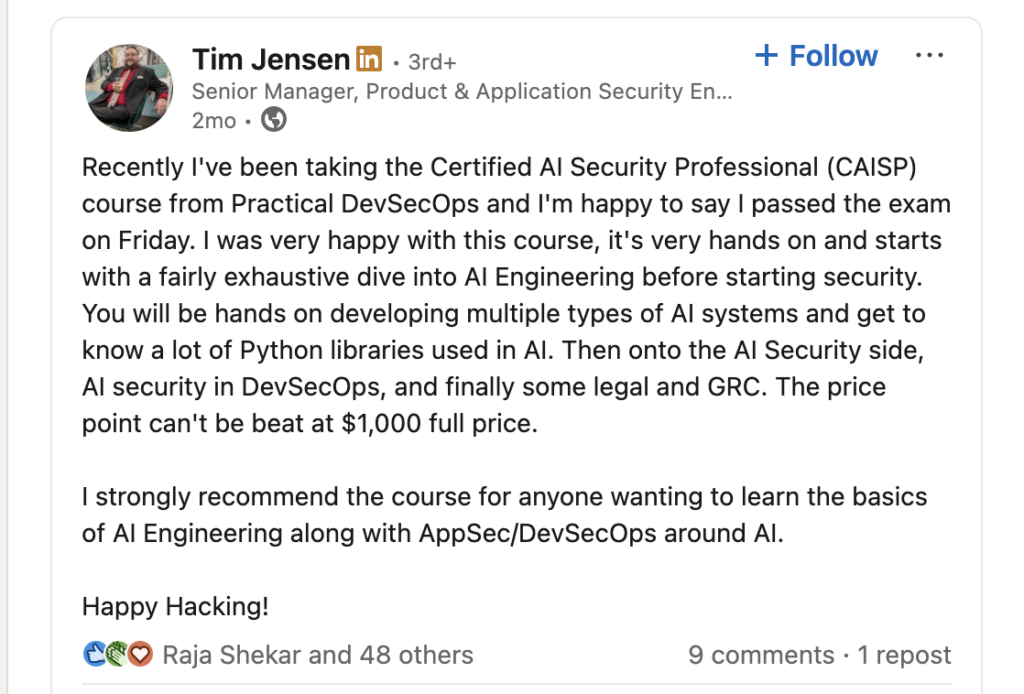
At $999, CAISP delivers measurable returns through immediate application:
- 30+ hands-on exercises – You apply skills directly to real AI systems, not theory you’ll forget next month.
- 60-day lab access – You work with actual GenAI pipelines, LLM vulnerabilities, and AI supply chain attacks starting day one.
- 3 years of course materials – You keep a reference library that stays relevant as threats evolve, revisiting content when new attack vectors emerge.
- 36 CPE points – You satisfy annual certification requirements without hunting for additional training.
- Get dedicated instructor support through the Mattermost channel – You connect with instructors and practitioners solving identical problems, cutting troubleshooting time when you hit issues.
- Browser-based labs – You skip setup headaches and start securing AI infrastructure within minutes.
- One exam attempt – You prepare seriously, no safety net that encourages procrastination.
What it covers
CAISP teaches how to attack and defend AI systems at the implementation level. The curriculum covers OWASP LLM Top 10, MITRE ATLAS, prompt injection, AI supply chain attacks, adversarial ML, and threat modeling with STRIDE applied to AI pipelines. It’s built for engineers who need to touch the code, not just audit the policy.
The labs run in a browser against real targets. You don’t configure a local environment to start. A student learning prompt injection executes it against a real LLM deployment, not a simulated one.
What our data shows
The CAISP has been trusted by 12,500+ learners and carries a 4.8/5 rating across 170 reviews. The profiles publicly documented span a wide range of roles: Security consultants and architects reported the most specific skill gains. Mohammad Golmohammadi, a security consultant, said the course gave him a much deeper understanding of AI security, especially around threat modeling for AI systems, securing AI in CI/CD pipelines, and defending against supply chain attacks. It also covered how to harden AI models and introduced governance and compliance standards crucial for enterprise environments.
The hands-on labs build, attack, and secure real AI systems, and that’s what makes the course stand out. Support teams helped whenever students ran into issues, making the whole experience smoother. Rustam Rakhimov found that even with limited time, the CAISP gave him strong foundational insights into AI security. The course didn’t just stop at attacks, it also emphasized defensive security engineering for anyone working at the intersection of AI and cybersecurity.
Honest limitations
CAISP is a practitioner cert, not a governance cert. It won’t prepare you for an AI audit role or a CISO-level risk conversation with the board. If your job is policy, risk frameworks, or compliance, look at AAISM or AIGP instead.
The 60-day lab access resets on a pay-to-extend model after that window. Engineers who need to revisit labs during a real project need to plan for that cost.
Certified AI Security Professional
Secure AI systems: OWASP LLM Top 10, MITRE ATLAS & hands-on labs.

2. Advanced in AI Security Management (AAISM)
Provider: ISACA Cost: ~$599 exam fee + 799–2,500 training (region-dependent) + application fee Exam format: MCQ Labs: None Prerequisites: Must hold CISM or CISSP. Hard gate, not a recommendation.
From earlier in this research conversation, Caio Correa (Australia, cybersecurity professional) passed AAISM and described the post-certification practical value: the credential helps establish practical AI governance and accountability models, identify AI security and operational risks, embed security controls throughout the AI lifecycle, and align AI initiatives with organizational policies, regulatory requirements, and risk appetite. His framing is governance-first, not technical. The AAISM exam leaned heavily on governance decisions in messy real-world scenarios, so mapping roles, accountability, and lifecycle checkpoints helped answer quickly.
What it covers
AAISM addresses AI security from a management and program-building perspective. The three published domain areas are AI governance and program management, AI risk management, and AI technologies and controls. This is the cert for someone who’s responsible for an organization’s AI security program, not for someone executing within it.
ISACA’s frameworks align with NIST and ISO standards, which matters for enterprise security teams operating in regulated environments. The EU AI Act compliance angle is genuinely relevant for 2026.
Honest limitations
No hands-on labs. You won’t leave this cert knowing how to stop a prompt injection attack. The training cost variability ($799 to $2,500 depending on region and provider) makes total cost harder to predict than it should be. AAISM launched in August 2025 and is new enough that employers may not recognise it without explanation. Unlike CISM or CISSP, which carry decades of market familiarity, AAISM holders may need to brief hiring managers on what the credential actually demonstrates. ISACA’s exam materials are also separate purchases from the exam itself.
The MCQ format rewards scenario-based questions.
Who it’s for
CISOs and security managers building an enterprise AI security program. Also relevant for professionals who need a credential that maps to NIST AI RMF or EU AI Act compliance obligations. Not for engineers who need hands-on technical depth.
3. SEC535: Offensive AI – Attack Tools and Techniques
Provider: SANS Institute Cost: ~$5,250 course + $949 GIAC exam fee (GOAA) Exam format: Practical exam (GIAC Offensive AI Analyst; GOAA, CyberLive format; not MCQ) Labs: Course labs only; no post-course access. Prerequisites: No hard prerequisite; offensive security background recommended.
| Format | Duration |
| Instructor-led (in-person or live online) | 3 days |
| Self-paced (OnDemand) | 18 hours |
| CPE credits awarded | 18 CPEs |
What it covers
SEC535 focuses on using AI to accelerate offensive security work. The published curriculum covers engineering AI-powered attack tools, OSINT automation, social engineering at scale, and deepfake-based attack scenarios. The course also addresses attacking AI systems, not only using AI to attack other targets.
Honest limitations
At $6,200+ all-in (course + exam), this is one of the most expensive options on this list. SANS has no post-course lab access. If you don’t reinforce the skills immediately, retention drops fast. The GIAC exam measures understanding, not execution under pressure.
Who it’s for
Experienced red teamers and pen testers who need to demonstrate AI-specific offensive skills for enterprise or government roles, and whose employer covers training costs. Difficult to justify at personal expense given CAISP’s comparable AI attack coverage at a fraction of the cost.
4. SEC598: AI and Security Automation for Red, Blue, and Purple Teams
Provider: SANS Institute Cost: ~$8,780 course (ILT, 6 days) + $949 GIAC exam fee Exam format: Written exam (GIAC AI Security Automation Engineer; GASAE) Labs: 25 browser-based labs across 6 days; no post-course access. Prerequisites: No hard prerequisite. Basic cybersecurity knowledge, Python, PowerShell, and cloud security experience recommended.
SEC598 has real demand, employer-funded practitioners with serious credentials, and active enrollment. It has zero independent post-course reviews available publicly as of October 2026. Anyone making a buying decision right now is acting on course design, instructor credentials, and SANS brand reputation alone, not peer validation.
What it covers
SEC598 covers AI/LLM integration into security workflows from both offense and defense angles. The 2025 update added content on agentic AI and continuous purple teaming. Published curriculum areas include building AI-driven red team agents, LLM-powered detection, SOAR integration (Tines), MITRE ATT&CK emulation, and cloud-native automation across AWS and Azure.
This is a broad course. It covers more ground than SEC535 and is priced accordingly.
Honest limitations
At nearly $9,730 all-in, this is the most expensive option on this list by a significant margin. The 6-day format compresses a lot of content. No lab access after the course ends means you need to apply what you learned immediately or the investment degrades quickly.
SEC598 suits SOC leads and security architects who already know these domains and need a unified AI and automation framework. For them, the breadth is the value. Specialists needing production depth in SOAR, cloud detection, or adversary emulation get too little per domain. The course integrates well. It doesn’t build deep.
Who it’s for
SOC engineers, purple teamers, and detection engineers whose employers are funding the training and who need to demonstrate cross-disciplinary AI security skills for large enterprise or government roles. The SANS brand matters most here for the audience this cert targets.
5. ISACA Advanced in AI Audit (AAIA)
Provider: ISACA Cost: ~$599 exam fee + 799–2,500 training (region-dependent) Exam format: MCQ Labs: None Prerequisites: Must hold active CISA, CIA, or CPA. ISACA also recommends 3+ years in audit/risk/compliance with at least 1 year in technology-related auditing.
Tomiyama Luca (CISA/CIA/CPA, Japan) passed in June 2025 after two weeks of focused study. She found the actual exam leaned more toward traditional ML and DL than the QAE suggested, and flagged severe time pressure with roughly one minute remaining after 90 questions.
Dr Baz Abouelenein passed in January 2026. His core finding: the exam doesn’t test exotic AI knowledge. It tests whether you apply audit judgment to the specific scenario, not the textbook answer. Domain 2 (AI Operations) is 46% of your score. Candidates who split study time equally across three domains systematically underprepare for the domain that decides the result. The trap answer is the one that’s correct in general but wrong because the scenario already moved past it.
What it covers
AAIA covers AI auditing from a controls and accountability perspective. Published domain areas include AI governance and risk, AI operations auditing, and AI auditing tools. The cert is positioned for the EU AI Act environment, where third-party audits of high-risk AI systems are becoming required.
For organizations subject to the EU AI Act’s conformity assessment requirements, having a credentialed AI auditor on staff or on retainer is a compliance necessity, not a nice-to-have.
Honest limitations
Hard prerequisite – You must hold an active CISA, CIA, or CPA to sit the exam, which rules out most security practitioners who aren’t already in audit tracks. No labs. MCQ-only. The training cost variability is the same problem as AAISM: actual total cost depends on region and training provider. AAIA launched in May 2025 and has a short track record in the job market.
Who it’s for
IT auditors and compliance officers whose organizations are subject to AI-specific regulations. The EU AI Act compliance angle makes this cert more directly useful in 2026 than it would have been in 2024. Not for engineers or managers looking for implementation depth.
6. Certified AI Governance Professional (AIGP)
Provider: IAPP Cost: $550 for IAPP members, $750 for non-members. IAPP membership costs $275/year and covers the certification maintenance fee. Add training costs on top. Exam format: MCQ Labs: None Prerequisites: None stated. IAPP recommends experience in AI, privacy, data governance, or compliance. Note: AIGP is not ANAB accredited at this time, unlike IAPP’s older credentials.
Practitioners who passed AIGP call it a solid governance vocabulary foundation, not a job-readiness credential. Hiring managers report certified candidates couldn’t execute day-to-day controls, continuous monitoring, or technical risk assessment. The cert earns its place as a starting point for legal and privacy professionals entering AI governance. It doesn’t finish the job.
What it covers
AIGP covers AI governance from a legal and regulatory perspective. Published exam domains include AI laws and regulations (EU AI Act, GDPR, CCPA), AI governance frameworks, risk management, and responsible AI principles. IAPP has built a strong brand in privacy law circles, and AIGP benefits from that credibility with legal and compliance audiences.
The cert is explicitly designed for professionals who work at the intersection of AI technology and law. It’s not trying to teach you to secure a model. It’s trying to make you credible in a boardroom conversation about AI regulation.
Honest limitations
No technical depth. No labs. The regulatory landscape this cert covers is also the fastest-changing part of AI governance. A cert earned in 2025 may need refreshing as EU AI Act implementation guidance continues to develop through 2026 and beyond.
Who it’s for
Privacy lawyers, legal counsel, GRC leads, and data officers whose work involves advising on AI regulation and governance. The IAPP brand carries real weight with legal and privacy audiences. Not for security engineers or technical roles.
Salary data for AI security roles in 2026
Important: The salary ranges below are drawn from publicly available compensation data. Each range must be cited with a specific source, report name, and the month and year the data was collected before this article was published.
AI Security Engineer: $152,773 – $189,934
ZipRecruiter and Glassdoor data from August 2026 show AI Security Engineers averaging $152,773 to $189,934 per year, with the full posted range spanning $61,500 to $293,246.
Source: ZipRecruiter and Glassdoor, August 2026.
AI/ML Security Engineer: $152,000–280,000+
The title splits into 2 pay bands depending on focus. For adversarial ML and red team work, Google posted a Software Engineer, Adversarial ML, Red Team role at a disclosed base of 147,000–211,000 (Google via anitab.org job board, April 2026). An AI/ML Security Engineer focused on machine learning security or MLSecOps, hardening infrastructure where models are trained, is projected at $200,000 to $280,000 or more in 2026.
Sources: Google job posting via anitab.org
LLM Red Team Specialist: $145,000–$255,000
The average AI Security and Red Teaming Specialist salary in the United States is $195,000 in 2026, with the full range spanning $145,000 at the 25th percentile to $255,000 at the 75th. Mid-level red team specialists earn $170,000 to $215,000.
Source: Orbyt Jobs Salary Explorer, April 2026. Data sourced from SEC filings, H-1B LCA (DOL), BLS OEWS, and aggregated job postings across 50+ platforms.
Lead AI Security Architect: $175,000–$280,000+
The national median salary for a Security Architect in 2026 is $175,000, with compensation typically ranging from $140,000 at the entry level to $225,000 for senior professionals. At the AI-specialist level, the average AI Architect salary in the United States is $195,000 in 2026, with the full range spanning $152,000 at the 25th percentile to $254,000 at the 75th. Principal and lead-level AI security architects at frontier labs reach $300,000+.
Sources: Careerscape Salary Guide, 2026; Orbyt Jobs Salary Explorer, June 2026.
AI Governance Lead: $120,000–$200,000
The average AI Governance Lead salary in the United States is $158,000 in 2026, with the full range spanning $120,000 at the 25th percentile to $200,000 at the 75th. Senior leads overseeing organisation-wide AI governance earn $185,000 to $225,000.
Data sourced from SEC filings
AI Security Specialist: $128,000–$195,000
The average AI Compliance Analyst salary in the United States is $145,000 in 2026, with the full range spanning $105,000 at the 25th percentile to $195,000 at the 75th. Experience with AI audit frameworks and bias testing methodologies adds 10 to 20% above general compliance salaries. Senior specialists reach $165,000 to $210,000.
Source: Orbyt Jobs Salary Explorer, April 2026
Which companies are hiring AI Security Engineers?
Organizations actively hiring AI security engineers and related roles as of late 2026 include OpenAI, Anthropic, Microsoft, Google, Meta, Amazon, and Visa. Specialized AI security startups including WitnessAI, Straiker, Astrix Security, Noma Security, and Relyance AI are also recruiting.
A standard CISSP gets you past the resume screen at most of these organizations. It doesn’t get you the role. The hiring managers for AI security positions are looking for demonstrated ability to secure LLM deployments, detect adversarial inputs, or build governance programs around AI risk. Your certification should map directly to one of those three.
How to choose
Answer 4 questions before picking a cert.
1. What do you do day-to-day?
If you write code, configure pipelines, run labs, or execute attacks: a technical cert (CAISP, SANS SEC535, SANS SEC598) gives you skills you can use within a week of finishing. If you write policies, manage risk programs, or advise on compliance: a governance cert (AAISM, AAIA, AIGP) maps to your actual work.
Don’t buy a technical cert to signal ambition if your job is policy. The credential won’t help you until your role changes.
2. Who’s paying?
If you’re paying personally: CAISP (999)orAIGP(799) are the two certs where the cost-to-value ratio is defensible on a personal basis. SANS at $6,200+ or $9,730+ is hard to justify without employer funding.
If your employer is funding: SANS becomes a serious option, especially if your organization’s hiring managers specifically filter for GIAC certifications.
3. Which regulatory environment are you in?
EU AI Act compliance is a live obligation in 2026 for many organizations. If your work involves advising on or auditing compliance with the EU AI Act, AAISM (management) or AAIA (audit) are the only certs on this list that map directly to that need. AIGP covers the legal and privacy layer of the same regulation.
If regulation isn’t your domain, ignore this filter.
4. What does your next role require?
Search 10 current job postings for your target role. Look at what certifications they list or prefer. If GIAC certifications appear consistently, SANS is worth the cost. If they mention ISACA credentials, that points toward AAISM or AAIA. If the postings don’t specify certs but emphasize hands-on AI security skills, CAISP’s practical exam gives you something demonstrable.
Quick routing guide
| You want to | Best Fit |
| Secure LLM pipelines and prove it with labs | CAISP |
| Build an enterprise AI security program | AAISM |
| Use AI to run offensive engagements | SANS SEC535 (with employer funding) |
| Add AI/automation to SOC and purple team work | SANS SEC598 (with employer funding) |
| Audit AI systems for EU AI Act compliance | AAIA |
| Advise on AI law and governance frameworks | AIGP |
Conclusion
AI security is a real specialization with real compensation premiums attached. The 6 certs on this list serve genuinely different roles, and picking the wrong track wastes money and time.
For engineers, CAISP is the most direct path to hands-on AI security skills at a cost you can justify personally. We built it, so take that recommendation with appropriate skepticism and read the disclosure at the top of this page. For governance and compliance professionals, AAISM or AIGP are the certs your industry actually recognizes. For red teamers with employer-funded training budgets, SANS SEC535 carries brand weight that matters in certain hiring contexts.
The one mistake to avoid: Choosing a cert because of salary ranges attached to the title. What pays is being able to do the work. The cert signals that you can. It doesn’t substitute for it.
Certified AI Security Professional
Secure AI systems: OWASP LLM Top 10, MITRE ATLAS & hands-on labs.
Key Takeaways
- AI security roles pay $152,000 to $280,000+ in 2026, with the biggest premiums going to engineers who can secure LLM pipelines hands-on.
- The top 6 AI security certifications cover four distinct tracks: hands-on technical, offensive AI, audit and compliance, and governance.
- CAISP is the strongest option for engineers. It covers OWASP LLM Top 10, MITRE ATLAS, adversarial attacks, and AI supply chain security with 30+ lab exercises.
- Adding a specialized AI security cert like CAISP correlates with a 15-20% salary premium over peers holding only generalist security certifications.
FAQs
The demand is real. The skills gap is real. How good the career is for you specifically depends on whether you’re willing to build technical skills, not just hold a credential. The market pays well for people who can secure an LLM deployment. It pays less for people who’ve only studied frameworks.
Safety is about ensuring AI systems behave as intended and don’t cause unintended harm, which includes alignment research, bias mitigation, and ethical AI design. Security is about defending AI systems against deliberate attack, including prompt injection, model theft, adversarial inputs, and supply chain compromise. Different disciplines, different job descriptions.
For CAISP: Python helps, particularly for the lab exercises. It’s not a hard requirement, but you’ll get more out of the hands-on content with at least basic scripting ability. For AAISM, AAIA, and AIGP: no. These are policy and framework certs with no technical prerequisites.
There is no single “best.” For hands-on engineering and red teaming, CAISP is the standard. For governance, audit, and management, ISACA’s AAISM can be a better choice. Choose the one that matches your actual daily tasks.
The Certified AI Security Professional (CAISP) from Practical DevSecOps is the strongest signal for technical AI security roles because it uses a hands-on practical exam, not multiple choice. For governance and regulated industries, ISACA AAISM carries weight if you hold CISM or CISSP. For broad employer recognition at resume-screening stage, CompTIA SecAI+ has the distribution. CISSP remains the baseline credential across all senior AI security job postings.
Technical execution roles (AI security engineer, LLM red team specialist, adversarial ML engineer) pay more than policy roles. Certifications that prove hands-on skill tend to correlate with technical roles. That said, salary is driven more by the role and the employer than by the specific cert. A CISO with AAISM will earn more than an individual contributor with CAISP.
Budget is the practical filter. CAISP at $999 with 60-day lab access is a defensible personal investment. SANS at 6,200–9,730 requires employer funding to make financial sense. If your employer funds SANS, the GIAC brand matters most in enterprise and government contexts. If you’re paying personally and need hands-on AI security skills, CAISP covers the technical core at a fraction of the cost.