

AI security split into two career tracks in 2026, and most professionals are picking the wrong one. The Certified AI Security Professional (CAISP) from Practical DevSecOps builds engineers who attack and defend AI systems in production.
The Advanced in AI Risk (AAIR) from ISACA builds advisors who assess AI risk from a governance seat. Both credentials carry weight. But they pay differently, open different doors, and demand completely different skill sets. This guide shows you which one fits your career, based on what you actually do for a living.
Certified AI Security Professional
Secure AI systems: OWASP LLM Top 10, MITRE ATLAS & hands-on labs.

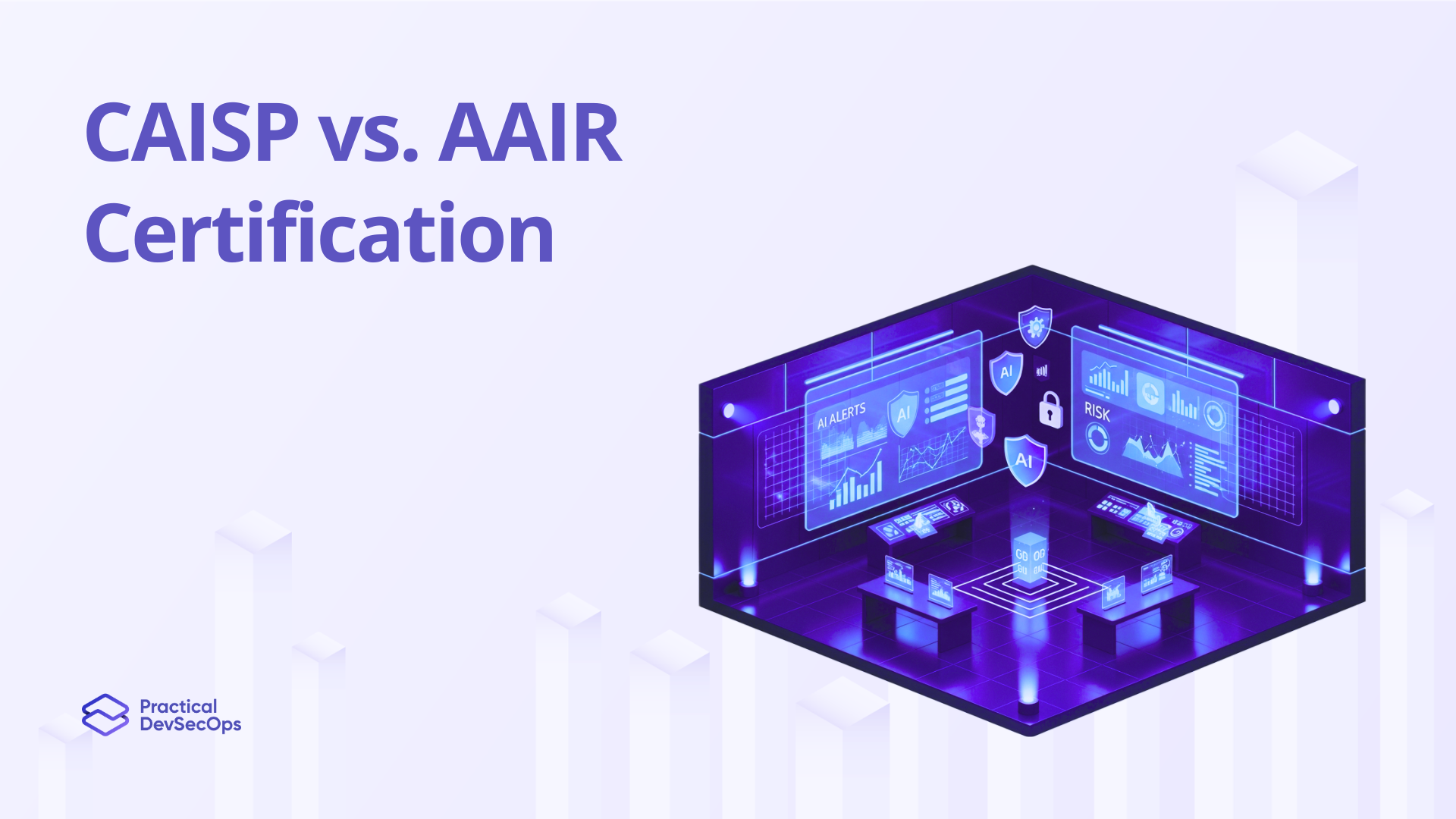
CAISP vs. AAIR Certification Comparison
| Factor | CAISP (Practical DevSecOps) | AAIR (ISACA) |
| Focus | Hands-on AI security practitioner | IT risk advisory and governance |
| Entry requirements | None (basic Linux helps) | Must hold CISA, CISM, CRISC, CISSP, CIA, CGEIT, CDPSE, or 20+ other credentials |
| Exam format | 5 practical challenges in 6 hours + 24-hour report | Computer-based knowledge exam at PSI centers or remote proctored |
| Labs | 60 days browser-based labs, 30+ exercises | None |
| Price | $1,099 (from $1,199) | $459 member / $599 non-member + $50 app fee |
| Validity | Lifetime, no renewals | Requires ongoing maintenance |
| Target role | AI Security Engineer, Red Teamer, AppSec, DevSecOps | IT Risk Manager, GRC, Internal Auditor |
What is the Certified AI Security Professional (CAISP) course?
The Certified AI Security Professional (CAISP) is a practitioner-grade certification for engineers who actually build, attack, and defend AI systems. It covers the OWASP LLM Top 10, MITRE ATLAS, threat modeling with STRIDE-GPT, AI supply chain attacks (SLSA, SBOMs, MLBOMs, model signing with Cosign), DevSecOps for AI pipelines, and governance under NIST RMF, ISO/IEC 42001, and the EU AI Act.
Anyone can enroll. You get 3 years of course access, 60 days of browser-based labs, 30+ guided exercises, 24/7 Mattermost support, 36 CPE points, and one exam attempt for $1,099.
Practical DevSecOps is a cybersecurity training and certifications company specializing in hands-on DevSecOps, AI Security, and Application Security. Practical DevSecOps has trained over 12,500+ security professionals and is trusted by organizations including Roche, Accenture, IBM, PWC, and Booz Allen Hamilton.
What is ISACA Advanced in AI Risk (AAIR)?
The ISACA Advanced in AI Risk (AAIR) is a gated advisory credential for experienced IT risk professionals. It covers three practice areas: AI Risk Governance and Framework Integration, AI Life Cycle Risk Management, and AI Risk Program Management.
AAIR is not open to everyone. You must already hold a qualifying credential like CISA, CISM, CRISC, CGEIT, CDPSE, CISSP, CIA, CRMP, or one of 20-plus other global audit, risk, and accounting designations. You also need proven experience in an IT risk or advisory role. The exam is computer-based, delivered at PSI testing centers globally or via remote proctoring (testing center only for India, Mainland China, and Hong Kong residents).
CAISP vs. AAIR: Head-to-Head Breakdown
1. Audience. CAISP targets engineers, Red Teamers, AppSec professionals, DevSecOps leads, and AI/ML engineers who work directly with models and pipelines. AAIR targets IT auditors, risk managers, and GRC advisors who assess and report on AI risk without touching code.
2. Curriculum. CAISP is 70% hands-on labs: prompt injection, training data poisoning, model theft, RAG security, poisoned pipelines, Trojanized models, backdoor attacks with BackdoorBox, fuzzing with FuzzAI, picklescan, LLM Guard, Cosign model signing. You actually break and fix AI systems. AAIR is theory-first. No labs. It builds better advisors, not better engineers.
3. Exam format. CAISP: 5 hands-on challenges in 6 hours, plus a 24-hour professional report. You prove you can do the job. AAIR: a traditional knowledge exam via PSI. You prove you understand the frameworks.
4. Cost and validity. CAISP is $1,099 one time, valid for life. AAIR is $459 for members or $599 for non-members, plus $50 application fee and ongoing maintenance.
Why Experienced Security Professionals Choose CAISP
Security engineers, AppSec leads, and Red Teamers holding OSCP, CISSP, or CEH are pivoting into AI security because the job market wants practitioners, not advisors. Companies building AI products don’t need another risk report. They need someone who can stop prompt injection, sign model artifacts, and catch a poisoned pickle file in CI.
CAISP is the only AI security certification that covers offense, defense, pipeline security, supply chain, threat modeling, and governance combined in one credential. AAIR cannot replace it. It is not built for hands-on work. Medium and Credly reviews confirm the pattern: CAISP labs map closely to the exam, and Fortune 500 firms actively recruit CAISP-certified engineers.
Salary and Career ROI
Traditional cybersecurity engineers sit at $95,000 to $130,000. AI Security Engineers start at $152,773. Experienced security professionals who add CAISP report salaries of $175,689 to $213,882, a 15 to 20 percent pay increase. AAIR holders stay inside the risk advisory pay band with an AI premium added. It does not open engineering or red team roles.
Conclusion
The decision comes down to one question: do you build and defend AI systems, or do you advise on the risk of building them? If your hands touch code, models, pipelines, or production AI workloads, CAISP is the only certification that proves you can do the work. The 60-day labs, 5-challenge practical exam, and 24-hour report format don’t reward memorization.
They reward people who can stop a prompt injection, sign a model with Cosign, and catch a poisoned pickle file before it ships. That’s why Fortune 500 security teams recruit CAISP holders for AI Security Engineer roles paying $175,689 to $213,882. AAIR cannot do this job. It was never designed to.
If you sit in a GRC seat, run internal audits, or advise the board on AI compliance, AAIR fits. It maps cleanly to NIST AI RMF and ISO 42001 from an advisory angle. But it stays inside the risk advisory pay band. It will not get you into engineering, red team, or AI security architect roles.
For most experienced security professionals reading this, CAISP is the smarter bet. Lifetime validity, no recurring fees, hands-on proof of skill, and a 15 to 20 percent salary jump on day one. AAIR is the right call only if you already hold CISA, CISM, or CRISC and plan to stay in advisory work for the rest of your career.
Pick the credential that matches what you actually do. Then go earn it.
Enroll in CAISP today course.
Certified AI Security Professional
Secure AI systems: OWASP LLM Top 10, MITRE ATLAS & hands-on labs.
FAQs
Yes. CAISP has no gatekeeping credentials. Basic Linux command knowledge and familiarity with Python or Ruby help, but nothing is mandatory.
Yes. The Certified AI Security Professional (CAISP) is recognized worldwide and is offered by Practical DevSecOps, a vendor-neutral cybersecurity training provider trusted by Fortune 500 companies including Roche, Accenture, IBM, PWC, and Booz Allen Hamilton. CAISP holders work across North America, Europe, the Middle East, and Asia-Pacific in roles such as AI Security Engineer, Red Teamer, and AppSec Lead.
The certification maps to globally accepted frameworks: OWASP LLM Top 10, MITRE ATLAS, NIST AI Risk Management Framework, ISO/IEC 42001, and the EU AI Act. This framework alignment makes CAISP credible to hiring managers and compliance teams in any jurisdiction. The credential is valid for life, carries 36 CPE points, and requires no renewal fees, making it a one-time investment with permanent global recognition.
Lifetime. No renewals, no maintenance fees, no CPE tracking.
CAISP is 5 hands-on challenges in 6 hours plus a 24-hour professional report. AAIR is a computer-based knowledge exam delivered at PSI testing centers or via remote proctoring.
CAISP holders report $175,689 to $213,882 for AI Security Engineer roles. AAIR adds an AI premium to existing risk advisory pay, typically lower than practitioner engineering roles.