

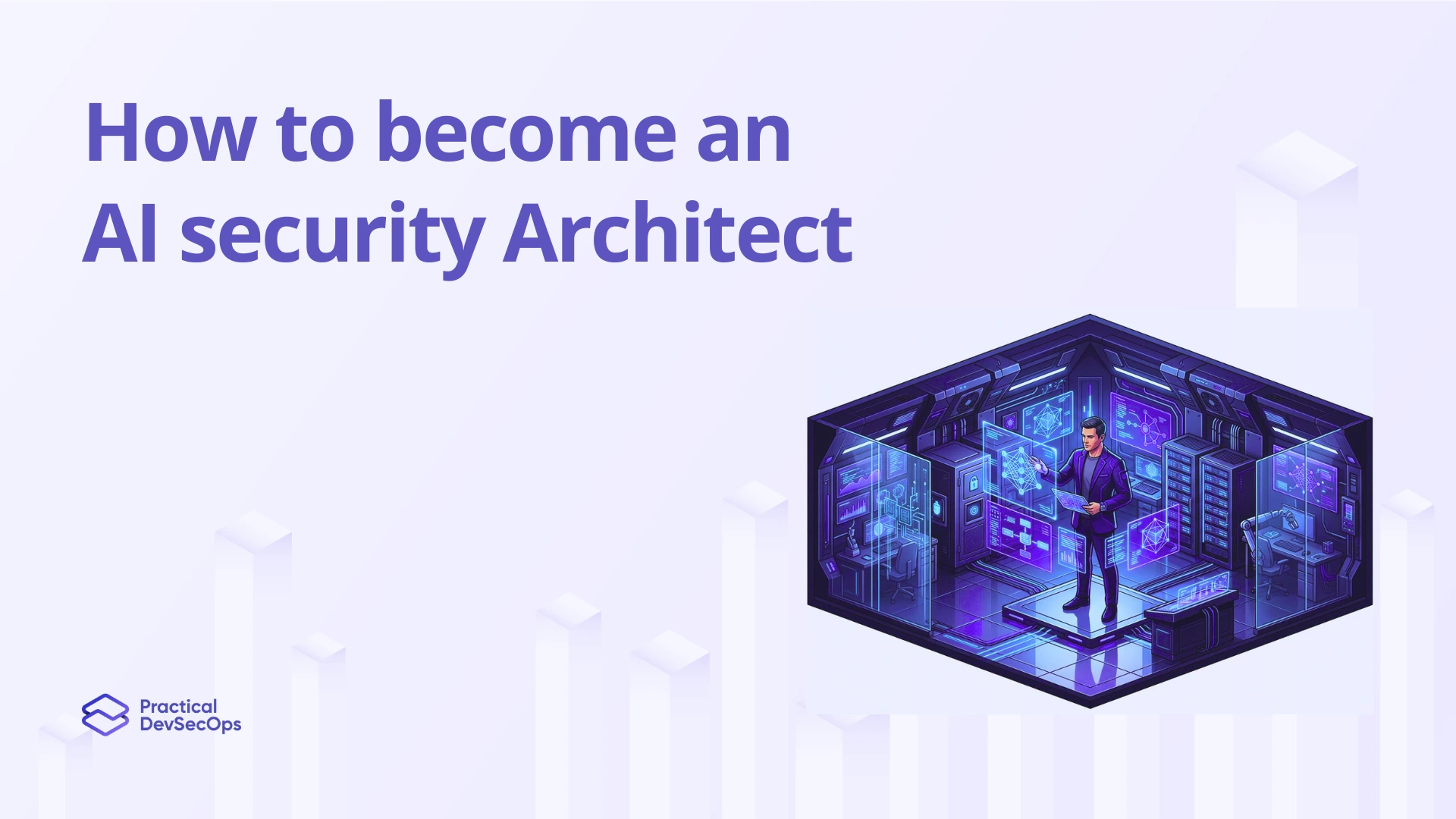
To become an AI security architect in 2026, you need three things most candidates skip: business decision skills, executive communication, and hands-on AI security knowledge backed by a lab-based certification. The pay is strong. AI security architect roles run about $200,000 to $280,000+ in 2026, and the engineering roles that lead there start around $152,773.
That’s because two shortages collided. Companies can’t find enough security architects, and they can’t find enough people who understand AI risk. If you can do both and speak to executives, you sit in the rarest, highest-paid corner of cybersecurity right now. Here’s the path.
What does an AI Security Architect actually do?
An AI security architect decides how a company can use AI safely to create business value. You work across security, engineering, legal, risk, and executive teams. Engineers build the systems. You decide whether they should be built, what data they touch, what controls they need, and who owns the risk.
Say a bank wants generative AI to summarize client portfolios. The engineer asks which model and which API. You ask whether the data is regulated, whether the model can leak sensitive information, how users get authenticated, and how outputs get validated before anyone trusts them.
| AI Security Architect | AI Security Engineer | |
| Main job | Decides how AI gets used safely and whether it ships | Builds and secures AI systems, pipelines, and infrastructure |
| Core question | Should we build it, and how? | Can we build it? |
| Works with | Executives, legal, risk, business units | Code, models, tools, cloud config |
| Skill focus | Decisions, business acumen, communication | Technical execution |
| Pay driver | Judgment and executive trust | Technical depth |
Why is demand for AI Security Architects exploding in 2026?
Demand is exploding because AI adoption is running ahead of security and governance. Only 11% of tech executives say they’re ready for AI agent rollout at scale, per IBM. 77% say AI adoption is outpacing their governance capabilities. And 70% of CIOs admit they have AI running on systems nobody told them about.
The World Economic Forum found 63% of employers see skill gaps as the top barrier to business transformation. ISC2’s 2025 workforce study found 73% of security pros expect AI to create demand for more specialized skills, and 72% expect demand for more strategic security thinking. That’s architecture work.
The pay follows the scarcity. AI security architect roles run about $200,000 to $280,000+ in 2026. The engineering roles beneath them start around $152,773, and a certification like CAISP takes that to $175,689–$213,882.
How do you become an AI security architect?
Build real security architecture skills
Data protection, threat modeling, cloud and application security, zero trust, identity and access, incident response, risk, and compliance. At the architect level, not the tool-operator level.
Learn AI systems and AI-specific risk
Model selection, data pipelines, AI agents, and the model lifecycle. Plus attacks like prompt injection, data poisoning, and model theft. You don’t write model code. You judge the risk.
Develop business acumen
This is where most people fail the interview. Connect security to revenue, cost, and risk. If you can’t tie your architecture to business value, executives won’t fund it.
Get sharp at executive communication
Translate technical risk into business language. Prompt injection becomes business process compromise. Shadow AI becomes uncontrolled enterprise exposure. Executives want the decision, the trade-off, and the impact. Not a 5-minute technical monologue.
Build a portfolio of decisions, not demos
Create business-first reference architectures: a secure AI customer service design, a healthcare AI compliance architecture, a financial services AI risk model. For each one, write the business goal, the risks, the controls, the trade-offs, and your executive recommendation. That’s what proves you think like an architect.
Why the Certified AI Security Professional (CAISP) is different
 Certified AI Security Professional (CAISP)7-day free trial
Open a live AI security lab in your browser today
Real targets, real terminals, no local setup.
Most AI security certifications are 2-day lecture courses with a multiple-choice quiz. Some, like ISACA’s AAISM, gatekeep you behind a required CISSP or CISM before you can even sit the exam. The Certified AI Security Professional (CAISP) from Practical DevSecOps is built differently. It’s hands-on, browser-based, and the exam itself is lab-based, so you prove skill by doing the work.
CAISP covers AI threat modeling with STRIDE, NIST AI RMF, ISO 42001, MITRE ATLAS, and the OWASP LLM Top 10. You get 60 days of browser-based lab access, 40+ guided exercises, 36 CPE points, and lifetime validity with no renewal fees. Practical DevSecOps has trained 12,500+ professionals, with enterprise clients including Roche, IBM, Accenture, and PwC.
That’s why security engineers trust it. The credential shows you can secure real AI systems, which is exactly what hiring managers look for in an architect.
Conclusion
The AI security architect role is exploding for a simple reason: AI is moving faster than companies can secure it, and few people can do both the technical and the business side. Build the security foundation, learn AI risk, and get sharp at executive communication. Want the hands-on AI security skills that back real architecture decisions? Enroll in the Certified AI Security Professional (CAISP) course and prove you can secure AI systems.
Certified AI Security Professional
Secure AI systems: OWASP LLM Top 10, MITRE ATLAS & hands-on labs.

FAQs
No. The role centers on decisions. You need to understand AI systems well enough to judge risk, data exposure, authentication, and controls. Engineers write the code. You decide how it gets secured and whether it ships.
An AI security engineer builds and secures the systems, pipelines, and infrastructure. An AI security architect designs the decision framework: what data AI can access, which risks are acceptable, and how the business uses AI safely. Engineers answer, “Can we build it?” Architects answer, “Should we, and how?”
AI security architect roles run about $200,000 to $280,000+ in 2026, depending on experience, industry, and clearance. The AI security engineering roles that lead into them start around $152,773, and a certification like the Certified AI Security Professional (CAISP) course takes that to $175,689–$213,882. Pay is high because qualified people are rare.
Yes, and it’s the most common path. If you have security architecture or senior security engineering experience, add AI-specific risk knowledge and business communication skills. A lab-based AI security certification like CAISP closes the technical gap fast.
No. A certification gets you pass resume filters and proves initiative. It won’t prove you can advise a CISO or make trade-off decisions. Pair the credential with a portfolio of architecture decisions and practice explaining risk in business terms.