

Summary
“Security best practices” is job-posting confetti. It sounds nice, screens nothing, and lets anyone with a LinkedIn buzzword bingo card sail through. CAISP is the opposite: 7 hands-on chapters, a 6-hour practical exam that can’t be memorized, and a verification link that puts pretenders in under a minute. Cost to require it: $1,099. Cost to skip it and mis-hire instead: up to $300K. That’s not a close call, that’s a typo you’re currently making in every posting.
Most DevSecOps job posts read like a shopping list: Kubernetes, Terraform, SAST, container scanning, five years of experience, bachelor’s required. Candidates who can actually do the job skim past it, because it looks identical to every other posting on the board.
That’s expensive. Offer acceptance for DevOps roles has fallen to 67% in 2026, down from 79% in 2022, and generic postings are a big reason why. A job that just lists tools and hopes someone qualified appears tends to attract “tool tourists,” candidates who can name products but can’t explain what broke during a failed rollout or how they handled risk under a tight release window.
The skills gap makes this worse, not better. Companies are chasing DevSecOps talent because DevSecOps engineers earn $20,000 to $40,000 more than standard DevOps roles at every level, yet over 37% of IT leaders still cite DevOps and DevSecOps as their biggest skills gap.
So a post that reads like every other one isn’t just ignored. It filters out exactly the people you’re trying to reach. Here’s how to write one that doesn’t.
Why the “Just Hire Someone With Both Skill Sets” Plan Falls Apart
A split hire creates its own tax. Someone strong in pipeline work but new to adversarial security spends months learning to read an attack the way a red teamer does. Someone strong in security but new to CI/CD spends that same stretch learning why a gate exists before they trust it enough to tune it.
Either gap shows up as slower triage. And slower triage is where compliance exposure lives: a missed vulnerability class or a misconfigured pipeline gate is exactly the kind of gap an auditor flags after the fact, not before.
Weigh that against the cost of closing the gap up front, and the math isn’t close.
| Cost driver | Typical exposure | Basis |
| DOL cost-of-bad-hire floor | 30% of first-year salary | ~$45,000 on a $150K DevSecOps salary |
| SHRM full replacement cost | 50%–200% of annual salary | $75,000–$300,000 on the same role |
| CAISP certification | $1,099 flat, one time | 36 CPE points, valid for life, no recertification |
Even at the DOL’s conservative floor, one mis-hire costs roughly 40 times what closing the gap costs up front. That’s before factoring in the audit finding that traces back to a triage process nobody documented, or the exposure that shows up once AI workloads enter a pipeline built for conventional code.
Why “Security Best Practices” Language Fails as a Filter
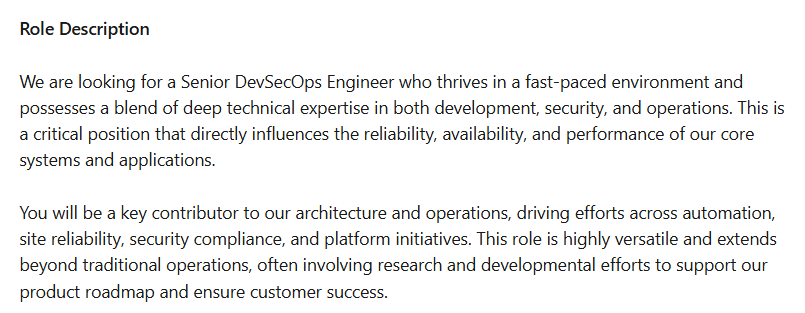
“Security best practices,” “strong understanding of secure coding,” “familiarity with DevSecOps principles.” These phrases feel professional. They also let almost anyone self-certify past your first screen, because there’s no way for a candidate to fail an unfalsifiable requirement.
A resume can claim familiarity. It can’t demonstrate it. A hiring manager reading fifty resumes in an afternoon has no reliable way to separate someone who read a few blog posts from someone who has actually fixed a poisoned dependency in a live pipeline.
The fix is to swap abstract skill language for something a candidate either has or doesn’t. A named, verifiable certification does that work: it forces a real credential number, a public verification link, and a defined scope of what the person was actually tested on.
Here’s what that looks like translated into job posting requirements:
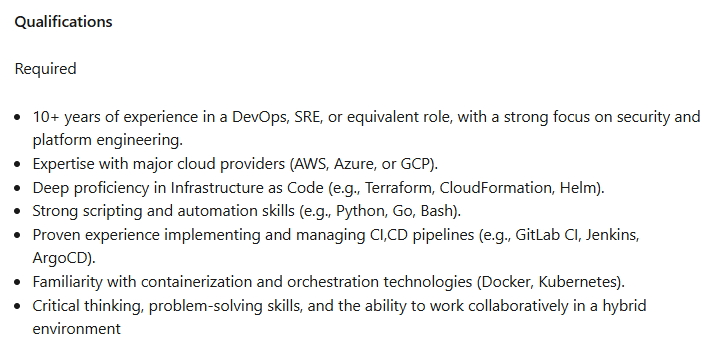
- Required: Certified AI Security Professional (CAISP) or equivalent hands-on AI/LLM security certification
- Required: working knowledge of the OWASP LLM Top 10, including prompt injection and insecure output handling
- Required: experience wiring security scanning (SAST, container scanning, dependency checks) into CI/CD pipelines
- Required: ability to run or support a vulnerability triage process, not just read a scanner’s output
- Preferred: hands-on experience with MITRE ATLAS or a comparable adversarial ML attack framework
- Preferred: familiarity with AI governance frameworks such as NIST RMF, ISO/IEC 42001, or the EU AI Act
- Preferred: a public, verifiable certification badge or transcript link included with the application
That last line matters more than it looks. Ask candidates to include a verification link, not just a claimed credential on a resume. Practical DevSecOps publishes a public certificate verification tool and digital badges for exactly this, so a recruiter can confirm a CAISP claim in under a minute instead of taking it on faith.
What each requirement actually screens for
Each line above exists to catch a specific failure mode. Here’s the mapping, so you’re not just copying requirements, you understand what happens if you drop one.
| Requirement | What it screens for | What slips through without it |
| CAISP or equivalent certification | Hands-on lab time attacking and defending real LLM systems, not just reading about them | Whether the candidate has a shared vocabulary with your existing AppSec team |
| CI/CD security tooling experience | Whether the candidate can wire a scanner into a pipeline, not just run it manually | A security hire who can find vulnerabilities but can’t stop them from shipping |
| OWASP LLM Top 10 knowledge | Whether the candidate has a shared vocabulary with your existing AppSec team | Interviews that drift into buzzwords because neither side has a common framework |
| Vulnerability triage ability | Judgment: can they tell a real finding from noise under time pressure | Alert fatigue, ignored scanners, or worse, a real finding buried in false positives |
| MITRE ATLAS familiarity | Whether their mental model of “attack” includes model-specific tactics, not just OWASP web categories | Threat models that miss data poisoning, model theft, or supply chain attacks entirely |
| AI governance framework exposure | Whether they can translate a technical finding into what an auditor or regulator will ask for | Compliance gaps that surface during an audit instead of during development |
Interview questions that verify the requirement, not just the resume line
A certification narrows the applicant pool. It doesn’t replace the interview, it changes what the interview needs to test.
- Instead of “are you familiar with prompt injection,” ask them to walk through how they’d triage a specific injection attempt in a sample log
- Instead of “have you worked with CI/CD security tools,” ask which pipeline stage they’d gate a build at and why
- Instead of “do you know AI governance frameworks,” ask what evidence they’d hand an auditor to prove a model was threat modeled before shipping
- Ask them to point to a specific lab or exercise from their certification and explain what it taught them, not just that they passed
That last question is the fastest way to tell a candidate who did the hands-on labs from one who bought a badge and skimmed the material. Practical DevSecOps’ CAISP exam is task-based, five challenges in six hours with a written report, so a candidate who passed it should be able to describe a specific challenge in concrete detail.
The Certification That Actually Signals Hands-On Readiness: CAISP
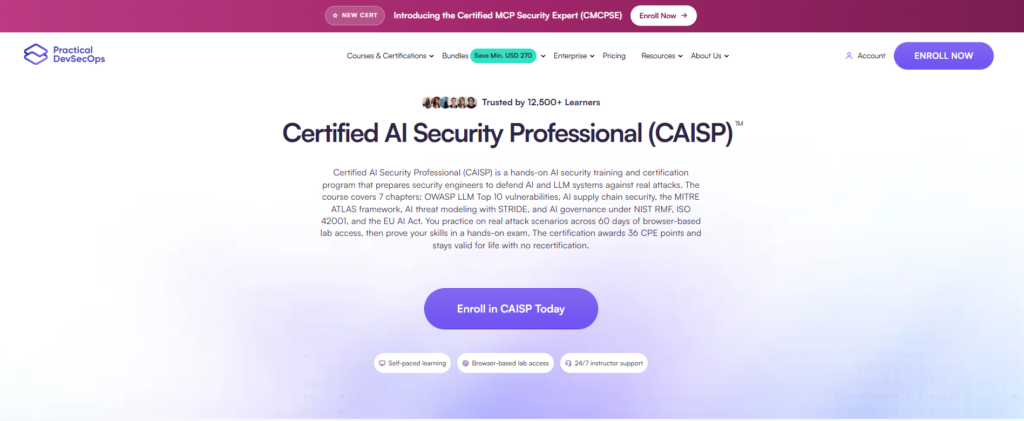
If a DevSecOps role’s scope includes securing AI/ML pipelines, LLM-integrated products, or model supply chains, one credential maps directly to that work: the Certified AI Security Professional (CAISP).
It’s built as a requirement or strong preference, not a nice-to-have line at the bottom of the posting. The distinction matters because a “nice-to-have” gets skipped by exactly the candidates you’re trying to filter for.
What CAISP actually does to your job requirement
- Completed 7 hands-on chapters covering the OWASP LLM Top 10, AI supply chain security, MITRE ATLAS, and AI threat modeling with STRIDE
- Applied AI governance concepts under NIST RMF, ISO/IEC 42001, and the EU AI Act, not just memorized the acronyms
- Practiced attacks and defenses across prompt injection, insecure output handling, training data poisoning, and model theft
- Worked inside 60 days of browser-based lab access built around real attack scenarios, no local VM setup required
Proof points worth putting directly in the job post
These are the specifics that separate CAISP from a resume line reading “AI security certified”:
| Proof point | Why it matters to a hiring manager |
| 60 days of browser-based lab access | The candidate practiced against live scenarios, not slides |
| 6-hour practical exam, task-based (not multiple choice) | Passing requires solving 5 challenges and writing up findings, the same motion as real incident work |
| 36 CPE points | Counts toward maintaining other security certifications the candidate may already hold |
| Lifetime validity, no recertification cycle | No lapsed-cert risk mid-project; what they proved on exam day still applies |
Why the trust signal matters for a job post
Practical DevSecOps has trained over 12,500 security professionals, and its certifications are used by security teams at organizations including Roche, Accenture, IBM, PwC, and Booz Allen Hamilton. For an HR team deciding whether to require a credential they’ve never heard of, that’s the difference between “unknown vendor” and “already vetted by orgs with a security bar of their own.”
For a candidate deciding whether it’s worth the time and the $1,099, that same list is the answer to “will anyone recognize this.”
For HR teams: Review the CAISP certification page before writing it into a job description, so the requirement matches what the exam actually tests.
How to Write the Requirement Into Your Posting
The template is short on purpose. Long, hedged certification language gives a recruiter room to skip it under time pressure. Use this line directly:
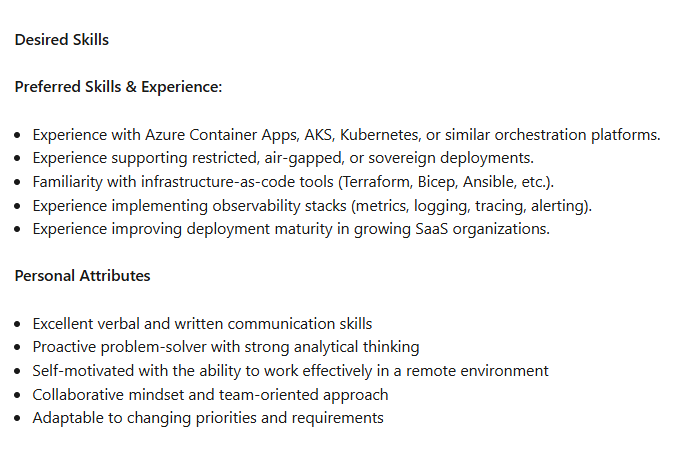
“Required/Preferred: Certified AI Security Professional (CAISP) or equivalent hands-on AI security certification.”
That’s it. No paragraph explaining what a certification is, no soft language like “ideally” or “a plus.” Either the role needs verified AI security skill on day one, or it doesn’t, and the posting should say which.
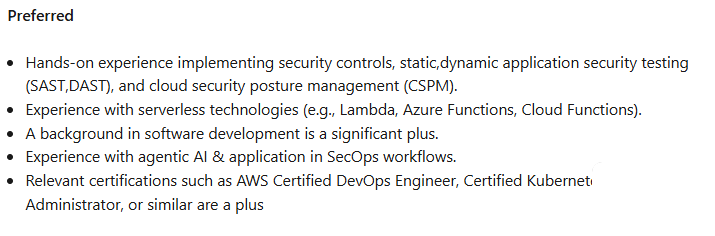
Deciding required vs. preferred
The split comes down to one question: if this person never touches an LLM pipeline, does the role still function? If the answer is no, make it required. If AI security is one responsibility among several, preferred is the honest label, and it still filters better than no mention at all.
A few concrete cases:
- A role explicitly titled AI Security Engineer, LLM Security Engineer, or AI Red Teamer: required. The job description is the certification’s scope.
- A DevSecOps Engineer or Pipeline Architect role where AI/ML workloads are one part of a broader CI/CD security mandate: preferred, with a note that it becomes required once AI workloads cross a certain share of the pipeline.
- A general AppSec Engineer role at a company that hasn’t shipped an LLM feature yet but plans to within the year: preferred now, flagged internally to become required at the next hiring cycle
- A Security Champion or generalist role with no AI-specific ownership: skip the requirement entirely. Forcing it in here is the same mistake as vague “security best practices” language, just with a certification name attached instead of a buzzword.
That last point matters. A certification requirement bolted onto a role that doesn’t need it reads exactly like the vague language this whole approach exists to replace. Requirement fatigue works the same way keyword stuffing does. A posting listing CAISP alongside four other tangential certifications signals a job description nobody edited, not a role with a genuine AI security surface.
Where the requirement sits in the posting
Placement changes how much weight applicant tracking systems and human reviewers give it. Put the certification requirement in the qualifications section, not buried in a bullet under “nice to have,” and repeat it once in the summary paragraph at the top of the post if your posting has one.
Most ATS keyword matching weighs the first 100 to 150 words of a description more heavily, so a requirement mentioned only in paragraph six of a long posting gets less algorithmic weight than the same line stated early.
| Role type | AI security requirement | Where it goes |
| AI Security Engineer / LLM Security Engineer | Required | Summary + qualifications |
| DevSecOps Engineer, AI workloads present | Preferred, reviewed for required at next cycle | Qualifications |
| General AppSec Engineer, no current AI scope | Not listed | Qualifications |
| MLOps Engineer | Preferred | Qualifications |
Verifying the Certification Isn’t Just a Resume Line
A certification name on a resume is a claim. Whether that claim is worth anything depends on three things a recruiter can check in a few minutes: the exam format, the CPE points awarded, and who issues the credential.
What to actually check
Judging exam format
- MCQ exams test recall. They’re passable via weekend memorization, no real system needed.
- Lab-based exams test work under time pressure. That’s a different, stronger signal.
- CAISP’s exam: 5 challenges in 6 hours, then 24 hours to write and submit a report.
- Mirrors a real AI security incident: find the issue, fix it, document what and why.
- A genuine pass-holder can describe the challenges in specific detail under follow-up questions.
- A candidate with a weaker or bought credential usually can’t get past surface-level description.
Checking CPE points
- CPEs are how the industry tracks whether a credential-holder keeps skills current.
- Major certs (CISSP, CISM, etc.) require a set number of CPEs per renewal cycle.
- A cert whose CPEs are accepted elsewhere is recognized by the broader ecosystem, not just its own issuer.
- CAISP awards 36 CPE points, usable toward renewing other security certs.
Checking the issuing body
- Search for the organization independently of the candidate’s resume.
- Look for listings on established industry indexes.
- Look for other named security teams referencing the credential publicly.
- Check whether the cert maps to standards your compliance team already recognizes.
The verification step itself
Ask candidates to include a verification link with their application rather than taking a resume line at face value. Practical DevSecOps publishes a public certificate verification tool and issues digital badges tied to each certification, so a recruiter can confirm the credential, its issue date, and its status in under a minute.
This one step closes a gap that resume screening alone can’t. Verification takes the certification claim out of the “trust the applicant” category and into the “confirmed” category, the same category a reference check or a background check occupies.
Key Responsibilities – Template
As a Senior DevSecOps Engineer, you will own security integration across our cloud-native platform, including any AI or LLM components it serves.
Automation, Site Reliability, and Cloud Operations
- Platform Engineering: Design, build, and maintain our core cloud-native platform infrastructure, including model-serving and RAG endpoints where the platform hosts AI features.
- Site Reliability: Design monitoring, logging, and tracing solutions that catch both conventional incidents and AI-specific failure modes, such as prompt injection attempts or anomalous model output, and own the alerting workflows that get them triaged fast.
- Operationalize New Technology: Evaluate and integrate emerging technologies, including LLM and agentic tooling, with an AI threat model as part of that evaluation before anything reaches production.
- Cloud Governance and FinOps: Implement cost control strategies that account for AI workload risk, including model supply chain and dependency review as part of any new integration.
- System Architecture and Design: Participate in architecture discussions for new and existing cloud-native applications, with explicit ownership of AI threat modeling using STRIDE for any system that trains, fine-tunes, or serves a model.
- Provide expert Field Support as the technical liaison for critical production issues, including incidents tied to model behavior, data poisoning attempts, or AI supply chain compromise.
Required: Certified AI Security Professional (CAISP) or demonstrated equivalent experience securing production AI or LLM systems.
Preferred: familiarity with AI governance frameworks such as NIST RMF, ISO/IEC 42001, or the EU AI Act, and hands-on experience with MITRE ATLAS or a comparable adversarial ML attack framework.
Reading the difference between formats
| Signal | Lab-based practical exam (e.g., CAISP) | Multiple-choice or open-book cert |
| What it tests | Applied skill under time pressure | Recall of terms and definitions |
| Time to prepare a fraudulent pass | Difficult; requires actual lab time | A weekend of memorization |
| What a candidate can describe afterward | Specific challenges, specific fixes | Vague generalities |
| CPE point recognition | Counts toward other major certs | Varies, often minimal |
| Recertification cycle | None for CAISP (lifetime validity) | Frequently annual, sometimes low-effort |
A cheap or easy credential isn’t automatically a red flag on its own; plenty of entry-level certifications are intentionally accessible as an on-ramp. The red flag is a credential that claims to certify hands-on readiness for a hands-on role while testing none of it. If a certification’s marketing describes practical skill and its exam is a closed-book quiz, that mismatch is the thing to catch before the requirement goes into a job post, not after a bad hire six months in.
Compensation, ROI, and Closing the Loop
Requiring a certification changes the applicant pool. It should also change the offer, because certified candidates are pricing themselves against a market that already pays for the skill.
What the market is paying
AI Security Engineer roles average $152,773 to $187,975 per year in the US, with the top 25% reaching $237,138 (ZipRecruiter and Glassdoor, 2026). That sits well above the broader information security analyst median of $124,910, with the top 10% above $186,420 (U.S. Bureau of Labor Statistics).
DevSecOps specialists carry a comparable premium over generalist roles: engineers with security-integration skills pull 10 to 20 percent more than standard DevOps positions, a gap that has held for roughly two years without narrowing. On base salaries that commonly run $110,000 to $360,000 for pipeline architect roles, that premium translates to a real, defensible number to point to during offer negotiation, not an arbitrary one.
The takeaway for a compensation band: if a posting requires CAISP or an equivalent, the offer should reflect the same market the certification signals into. Underpaying a certified candidate against that benchmark just pushes them toward a competing offer that matches it, and the search restarts.
Closing the loop on cost
Come back to the number from earlier in this piece. The US Department of Labor’s floor for a bad hire sits at 30 percent of first-year salary, and SHRM’s full accounting runs 50 to 200 percent of annual salary once replacement, onboarding, and lost productivity are counted. On a $150,000 DevSecOps salary, that’s $45,000 at the conservative floor and up to $300,000 at the high end.
Set that against a $1,099 certification cost, whether the candidate already holds it or the company sponsors it as part of an offer. The comparison isn’t close, and it doesn’t need to be dressed up: a verified, lab-tested credential is a small, one-time cost against a mis-hire risk that’s measured in tens or hundreds of thousands of dollars, plus the compliance exposure and ramp-up time covered earlier.
That framing works from both directions. HR teams get a plain ROI case for making the certification a hard requirement rather than a soft preference. Candidates weighing whether $1,099 and a few weeks of lab time are worth it get the same math from the other side: a credential that maps to a role paying $150,000 to $237,000 pays for itself the moment it moves an application past the first screen.
The closing move
None of this works as a one-line mention buried at the bottom of a job description. Put the requirement in the summary, verify it don’t just read it off a resume, and pay the market rate it signals. Do those three things and a DevSecOps posting stops attracting tool tourists and starts attracting the people who can actually secure what you’re shipping.
Final Thoughts
A job post that lists “security best practices” is a coin flip. A job post that requires a named, verifiable, lab-tested certification is a filter, and filters are the entire point of a job posting.
CAISP isn’t the only way to run that filter, but it’s the one built specifically for the AI/ML pipeline work most DevSecOps roles now touch: OWASP LLM Top 10, MITRE ATLAS, AI supply chain security, governance under NIST RMF and the EU AI Act. Require it or prefer it, price the role to match what certified candidates already command in the market, and verify every claim instead of trusting a resume line.
The math doesn’t leave much room for debate. A mis-hire costs $45,000 at the floor and up to $300,000 once you count replacement and lost productivity. The certification costs $1,099. Every day a posting runs without this filter is another day it’s screening for the wrong thing.
If you’re hiring: Look at the CAISP certification page and decide today whether your next DevSecOps posting lists it as required or preferred. Don’t let another req go live with vague language a bot can pass.
If you’re job hunting: Enroll in CAISP before you apply, not after a rejection tells you the gap existed. Sixty days of labs and a six-hour practical exam stand between you and a credential that recruiters can verify in under a minute.
FAQs
Require CAISP only when AI/ML security is core to the role from day one, such as an AI Security Engineer or LLM Security Engineer position. For roles where AI security is one responsibility among several, list it as strongly preferred and let it work as a tiebreaker between otherwise similar candidates.
CAISP costs $1,099. Set against the fully loaded cost of a mis-hire, recruiting fees, ramp-up time, and delayed security coverage, it functions as a low-cost, high-signal filter rather than an added barrier to entry.
Years of experience alone don’t confirm what that experience actually covered. A candidate willing to complete CAISP’s hands-on labs and six-hour practical exam demonstrates current, verifiable skill on top of tenure, not a substitute for checking it.
Yes. Many teams use CAISP to upskill current DevOps or security engineers into DevSecOps and AI security coverage rather than running an external search. Compare the sponsorship cost against your typical cost-per-hire before deciding which route is faster.
Candidates get 60 days of browser-based lab access. Motivated candidates typically complete all seven chapters and sit the six-hour practical exam well within that window.
CAISP is issued by Practical DevSecOps, which has trained more than 12,500 security professionals and is trusted by organizations including Roche, Accenture, IBM, PwC, and Booz Allen Hamilton. That track record is worth citing directly in a posting’s “certifications we value” section, so candidates see the credential is already vetted by comparable employers.