

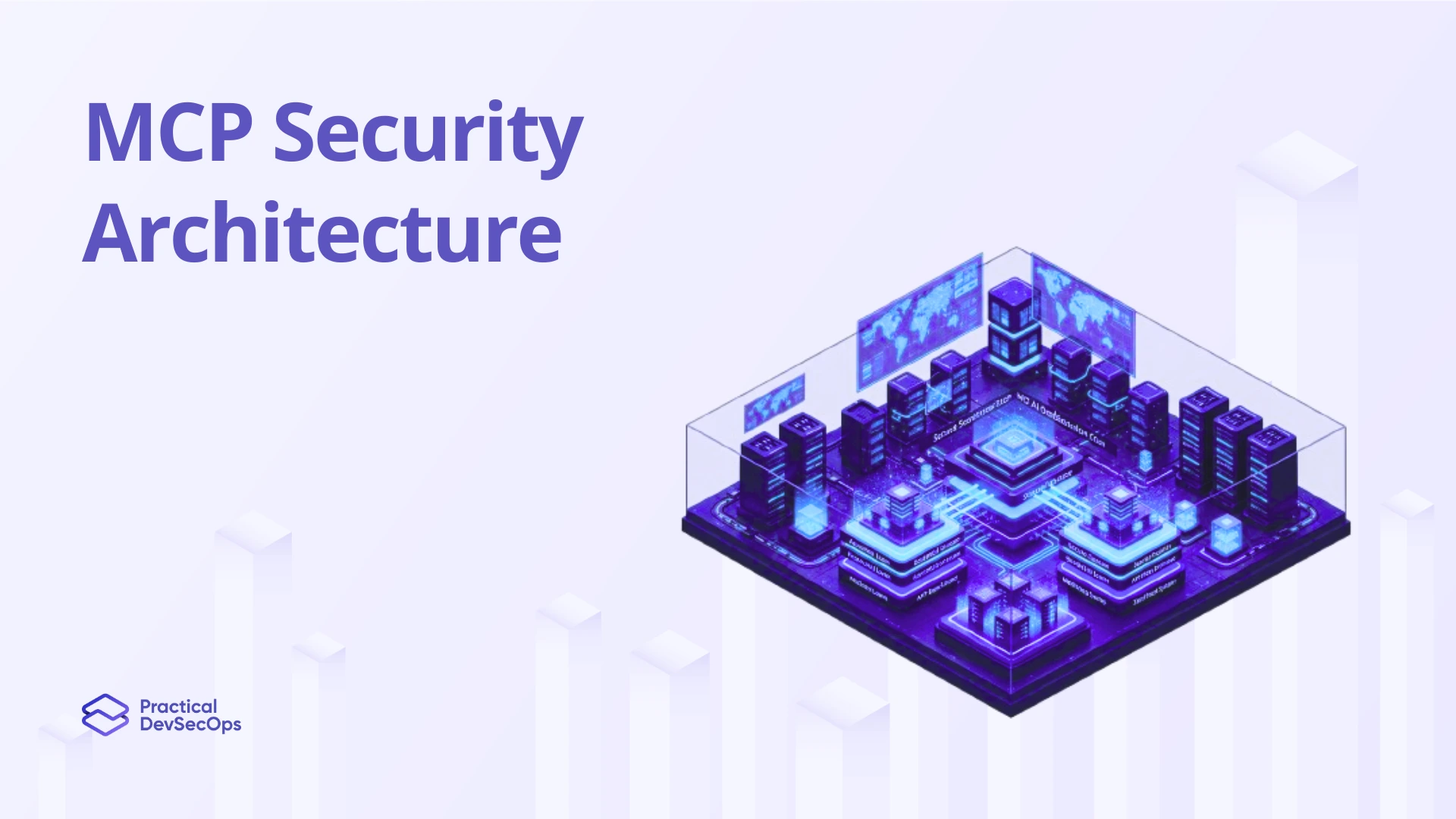
MCP security architecture is the design of trust boundaries, authentication paths, and runtime controls that stop Model Context Protocol installations from becoming the easiest entry point into your AI stack. The MCP specification states clearly that it cannot enforce security at the protocol level.
That responsibility sits with whoever ships the server, the client, and the host. This guide gives you the layered architecture model security professionals actually need. What each layer does, what attackers target, and the controls that hold up in production.
What MCP security architecture covers
The Model Context Protocol moves data, tools, and prompts between an LLM and external systems. Five things need protection: identity, transport, tool and resource definitions, runtime execution, and observability. Skip any layer and the rest stops working.
CISA’s May 2025 guidance and the OWASP MCP Top 10 say the same thing. Implementation owns the risk.
The 5 layers of a working MCP security architecture
OAuth 2.1 with PKCE is mandatory for HTTP-based MCP servers since the June 2025 spec revision. MCP servers act as OAuth Resource Servers. Authorization belongs to a dedicated identity provider.
- Use scoped tokens per server. Never share tokens across MCP servers.
- Publish a .well-known Protected Resource Metadata endpoint (RFC 9728).
- Start with minimal scopes like mcp:tools-basic. Elevate only via WWW-Authenticate scope challenges.
2. Transport security
TLS 1.2+ with strong cipher suites on every external connection. Add mutual TLS for server-to-server calls. Turn on DNS rebinding protection.
stdio transport is the safer default for local tools because the OS sandbox handles isolation. Streamable HTTP brings session ID risks. Session hijack prompt injection is a documented attack: an attacker who grabs a session ID sends malicious events to another server using it. Bind sessions to user identity, not session ID alone.
3. Tool and resource definitions
Treat tool descriptions as code. They get loaded directly into the model’s reasoning context. Whoever controls a description controls the model. Most tool poisoning and tool shadowing attacks target this layer.
Controls that work:
- Version, review, and sign tool descriptions.
- Run static analysis on tool metadata.
- Block descriptions from being modified by untrusted data.
- Pin server versions. No auto-updates in production.
- Subscribe to security advisories for every package and server.
CVE-2025-6514 (command injection through MCP server configuration) is the case study. Configuration files travelled inside repos and executed on first clone. No user interaction required.
4. Runtime isolation
Run every MCP server in a sandbox. Containers (Docker, Podman) are the baseline. For higher-risk servers use VM isolation via Firecracker or Kata Containers.
Network defaults must be deny-all egress. Most teams containerize the server and forget the network. The container still reaches arbitrary internet destinations and exfiltration becomes trivial.
Add seccomp profiles, AppArmor or SELinux policies, and minimal base images (distroless or Alpine).
5. Observability and governance
Log every tool call with the requesting identity, scope, and result. Send logs to your SIEM. Build behavioral baselines per server. Signature-based detection misses tool poisoning because the attack runs at natural-language semantics.
Maintain a central inventory of every MCP server in the organization. Without it, tool sprawl makes consistent controls impossible.
Pre-launch vs runtime controls
Pre-launch:
- Threat model each server. STRIDE works fine for MCP.
- Sign and verify tool descriptions.
- Pin versions.
- Static analysis on server code and metadata.
Runtime:
- Token validation on every call.
- Scope check against the requested operation.
- Egress allowlist enforcement.
- Audit log with correlation IDs.
- Anomaly detection on tool call patterns.
Common architecture mistakes
- Treating MCP servers as both resource and authorization servers. The June 2025 spec splits these. Use a dedicated IdP.
- Sharing tokens across servers. Each server gets its own scoped token.
- Wildcard scopes (*, all, full-access). Always scope per capability.
- Trusting config files inside cloned repos. Block any config that triggers install without explicit user consent.
- Containerizing without network isolation. Default-deny egress.
Conclusion
MCP security architecture is a way of thinking about trust boundaries in AI agent systems. Practical DevSecOps built the Certified MCP Security Expert (CMCPSE) program around hands-on labs covering OAuth 2.1 setup, tool poisoning attacks, sandbox configuration, and incident response for MCP environments. If you’re designing or reviewing MCP architectures in production, this certification maps directly to the work. Enroll in the Certified MCP Security Expert (CMCPSE) course.
FAQs
For stdio (local) transport, yes. The OS sandbox is the trust boundary. For HTTP transport, OAuth 2.1 with PKCE is mandatory under the current spec.
Default-deny egress on every MCP server container. Most exfiltration paths assume open outbound traffic.
Diff every tool description against a signed baseline on each load. Alert on any drift. Pair with behavioral monitoring on tool call patterns.