

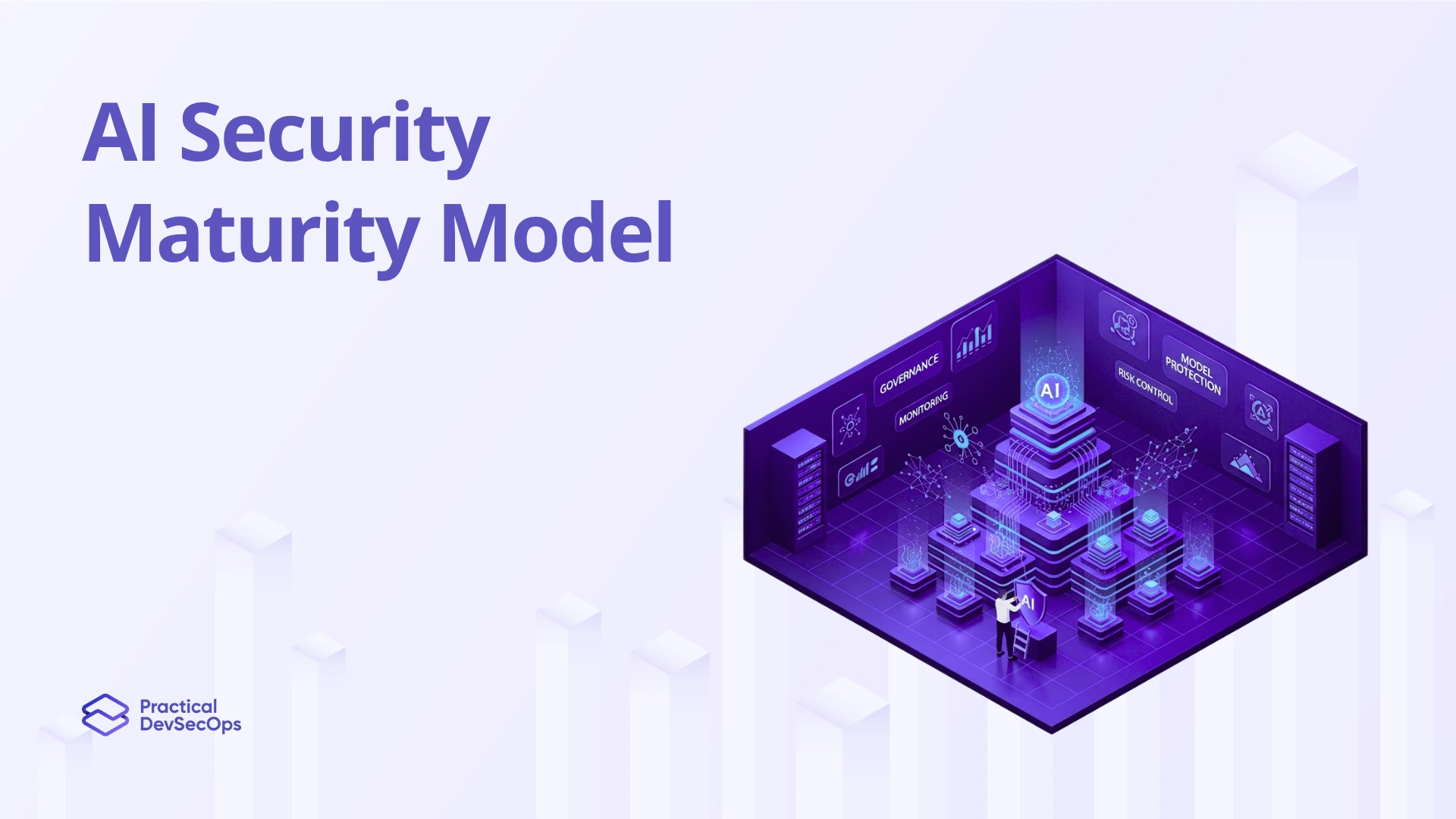
The AI Security Maturity Model is a framework that helps organizations measure and improve how well they secure their AI systems. It defines progressive levels, ranging from basic ad hoc security practices to advanced, fully automated ones. Each level guides teams on protecting AI models, data, and pipelines against threats like data poisoning, model theft, and adversarial attacks. It essentially acts as a roadmap for building stronger, more trustworthy AI security over time.
Most organizations think they have AI security covered because they deployed a prompt filter or ran one red team exercise. They don’t.
The AI threat surface in 2026 is not the same animal it was 18 months ago. Agentic systems now execute code, modify databases, and chain actions across enterprise tools. Cisco’s State of AI Security 2026 found that 83% of organizations planned to deploy agentic AI, but only 29% felt ready to secure it. That gap is where breaches happen.
A maturity model gives you a structured way to measure where you are and what to fix next. Here’s a practical one built for 2026 realities.
Certified AI Security Professional
Secure AI systems: OWASP LLM Top 10, MITRE ATLAS & hands-on labs.

The 5 Levels of AI Security Maturity Model Every Organization Needs in 2026
Level 0 – Unaware
No formal AI inventory. Security teams don’t know which AI models are running in production, what data they touch, or what tools they can invoke. This is more common than anyone admits.
Level 1 – Reactive
Basic prompt filtering exists. Maybe a WAF in front of an LLM endpoint. Security responds to incidents after they occur. No governance policy for AI agents or MCP connections. 79% of organizations are here.
Level 2 – Defined
An AI asset inventory exists. Policies are written. Red teaming happens at least once per quarter. Prompt injection and jailbreak testing are part of the release cycle. Human oversight is required before any autonomous action executes.
Level 3 – Managed
Runtime monitoring covers model inputs, outputs, and tool calls. Agent-to-agent interactions are logged and audited. Least-privilege access is enforced per agent identity. Behavioral drift triggers automated alerts. MCP server connections are scanned before onboarding.
Level 4 – Optimized
Continuous, automated maturity scoring. AI security controls are tested in production via adversarial simulation. Regulatory evidence (EU AI Act, NIST AI RMF) is generated automatically. Security posture updates in near real-time, not quarterly.
3 Critical AI Security Gaps Your Maturity Model Is Probably Ignoring
1. MCP Security Is a Maturity Dimension, Not a Footnote
Model Context Protocol became the standard way to connect LLMs to external tools in 2026. It also became a serious attack vector. Researchers found tool poisoning, remote code execution, and supply chain tampering inside MCP ecosystems. A fake npm package mimicking an email integration silently forwarded outbound messages to an attacker.
Your maturity model must include MCP server inventory, signing verification, and runtime scanning. If it doesn’t, you have a blind spot the size of your entire tool integration layer.
2. Multi-Agent Trust Chains Are the New Lateral Movement
A compromised research agent can insert hidden instructions into output consumed by a financial agent, which then executes unintended transactions. This is not theoretical. It happened in 2025 documented incidents.
Traditional IAM was built for human-to-system trust. Agent-to-agent trust requires a different model: cryptographic identity per agent, scoped permissions per task, and session-level audit trails. Most maturity frameworks don’t address this at all.
3. Multi-Turn Attack Resilience Is a Separate Metric
Single-turn jailbreak defenses are table stakes. Multi-turn attacks that unfold across extended conversations achieved success rates as high as 92% in testing across eight open-weight models. If your security posture only measures single-prompt resilience, you’re measuring the wrong thing for agentic deployments.
AI Security Maturity Self-Assessment: Find Out Which Level You Are At Right Now
Answer yes or no to each:
- Do you have a complete inventory of all AI models, agents, and MCP connections in production?
- Are agent-to-agent interactions logged and auditable?
- Do you test multi-turn attack resilience, not just single-prompt injection?
- Is least-privilege access enforced per agent identity, not per team?
- Can you generate EU AI Act compliance evidence automatically?
0–1 yes: Level 0–1. Start with inventory. You can’t secure what you can’t see.
2–3 yes: Level 2. Focus on runtime monitoring and MCP security.
4–5 yes: Level 3–4. Your next step is continuous automated scoring and regulatory automation.
What AI Security Maturity Level 3 Looks Like for Real Teams in 2026
For a 50-person security team:
One dedicated AI security engineer. Runtime guardrails on all production LLM endpoints. Quarterly adversarial red team exercises. A documented agent identity policy.
For a 500-person enterprise:
A formal AI Security Center of Excellence. Automated behavioral monitoring across all agent workflows. MCP server allowlisting. A live maturity dashboard updated from operational telemetry.
The controls are the same. The scale and tooling differ. Level 3 is not a luxury reserved for large enterprises. It is the minimum viable security posture for any team running AI agents in production.
EU AI Act and NIST AI RMF: What Maturity Level Do You Actually Need to Comply?
The EU AI Act mandates risk assessments for high-risk AI systems. NIST AI RMF provides a governance structure. Neither framework tells you what maturity level you need to be at to comply.
The practical answer:
- Level 3 is the minimum for any organization deploying AI in regulated industries. You need documented risk assessments, human oversight mechanisms, and audit logs. You cannot produce that evidence reliably at Level 1 or 2.
- Level 4 is where audit evidence generation becomes automated rather than manually assembled. For large enterprises targeting full EU AI Act compliance by the end of 2026, this is the target.
Organizations that treat compliance as a checkbox exercise will spend enormous time manually collecting evidence every audit cycle. Organizations at Level 3 and above generate that evidence as a byproduct of normal operations.
AI Security in 2026: What Separates Mature Organizations from Vulnerable Ones
AI security maturity in 2026 is not about having the most tools. It’s about having the right controls at the right layer: model, agent, protocol, and supply chain.
Most organizations are at Level 1 and calling it Level 3 because they have a prompt filter running.
Start with inventory. Build toward runtime observability. Treat agent identity as seriously as human identity. Stop measuring only single-turn defenses when your agents operate in multi-turn sessions.
The organizations that close this gap in 2026 will be the ones that don’t spend 2027 doing incident response on autonomous systems they didn’t fully understand.
Certified AI Security Professional
Secure AI systems: OWASP LLM Top 10, MITRE ATLAS & hands-on labs.
FAQs
It’s a structured framework that measures how well an organization identifies, governs, and defends its AI systems. It matters in 2026 because AI is no longer passive. Agentic systems take real actions. A weak security posture at Level 0 or 1 means autonomous systems are operating outside your line of sight, with no audit trail and no guardrails.
Traditional models were built for human-operated systems. AI security maturity adds dimensions that don’t exist in those frameworks: model behavioral drift, agent-to-agent trust, MCP protocol security, multi-turn attack resilience, and training data integrity. You need both, but you can’t substitute one for the other.
Conflating tool deployment with maturity. Having a prompt filter or a SIEM that ingests LLM logs does not make you Level 3. Maturity is measured by what you can detect, respond to, and prove. If you can’t generate an audit trail of every agent action and every tool call, you’re not as mature as you think.
MCP is now a primary attack surface. At Level 1, organizations have no MCP visibility at all. At Level 3, every MCP server connection is inventoried, signed, and scanned before onboarding. At Level 4, MCP connections are continuously monitored for behavioral anomalies. If your maturity model doesn’t include MCP as a control domain, it’s already outdated.
Level 3 is the practical floor for regulated industries. The EU AI Act requires documented risk assessments, human oversight mechanisms, and audit logs for high-risk AI systems. You cannot produce that evidence reliably at Level 1 or 2. Level 4 is where compliance evidence generation becomes automated, which is where most large enterprises should be targeting by end of 2026.