

In 2026, employers don’t care if you can recite “shift left” or explain the CIA triad on a whiteboard. They need engineers who can harden CI/CD pipelines, automate security scanning in Kubernetes clusters, and integrate AI-driven threat modeling into production workflows.
Here’s the problem. Most DevSecOps certifications still hand you a PDF study guide and test you on definitions through multiple-choice exams.
Meanwhile, real-world DevSecOps happens in terminals, YAML files, and cloud consoles. You’re expected to secure containerized applications, write policy-as-code, and respond to runtime threats.
We analyzed every major DevSecOps certification available in 2026. This is a practical comparison for practitioners who need to know which certification will actually improve their job performance. And which ones are expensive resume decorations?
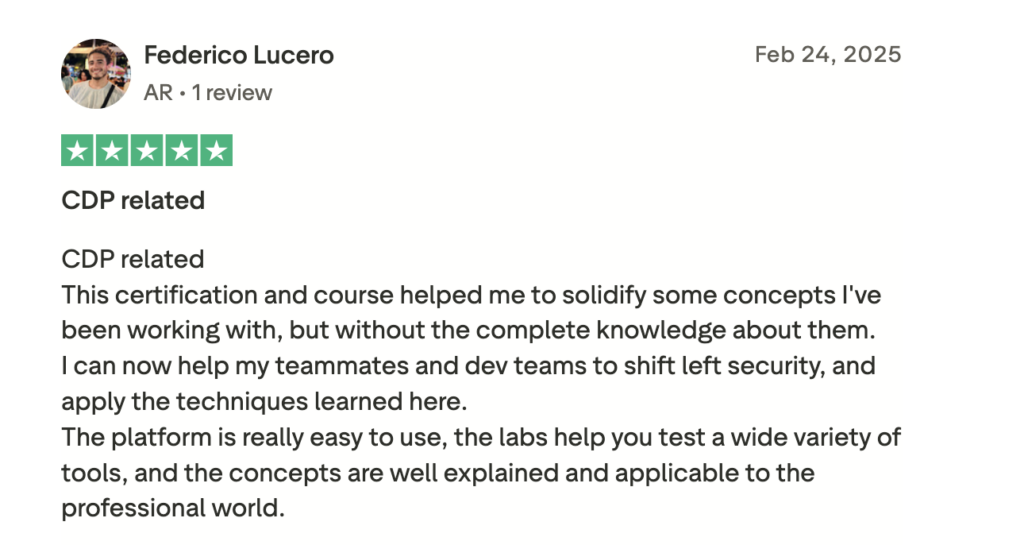
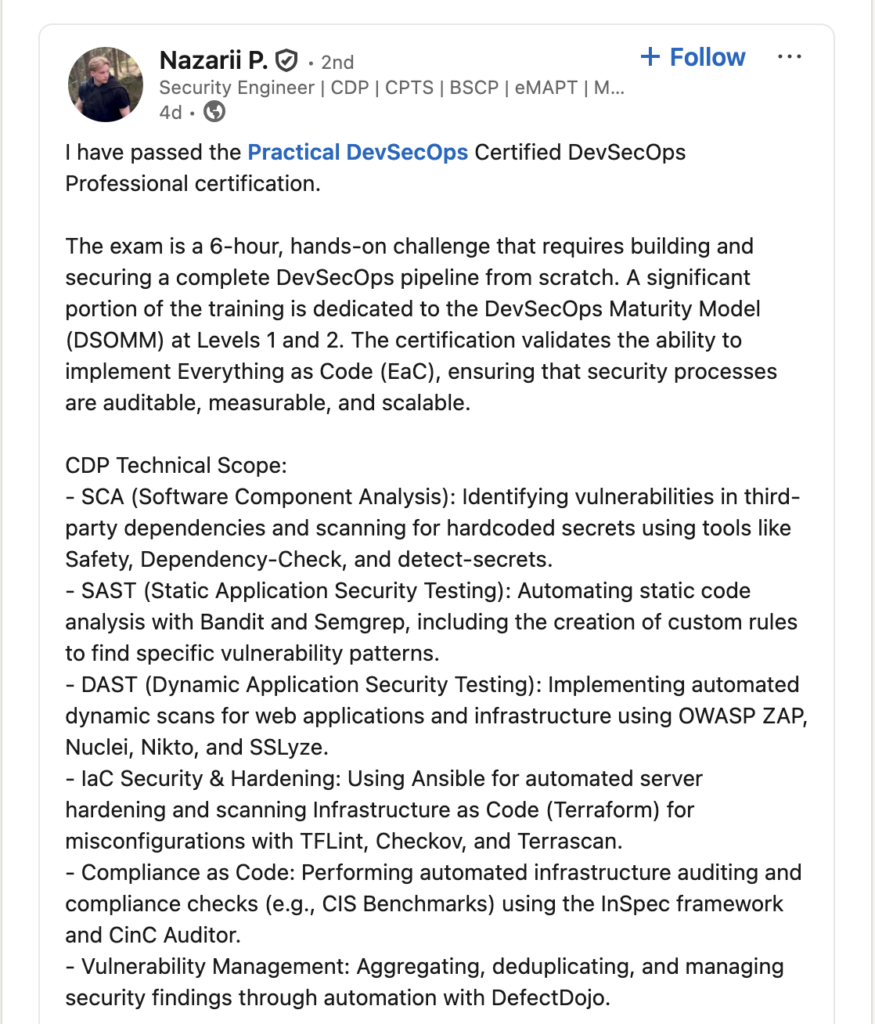
Here are the recent testimonials from the new learner who has completed the Certified DevSecOps Professional (CDP) course and shared their experience on TrustPilot:

Also read about the Why DevSecOps is a Promising Career Option
Top 5 DevSecOps Certifications in 2026 – Comparison
| Criteria | Certified DevSecOps Professional (CDP) | SEC540: Cloud Native Security | DevOps Institute (DevSecOps Foundation) | EC-Council (ECDE) |
| Provider | Practical DevSecOps | SANS Institute | DevOps Institute (PeopleCert) | EC-Council |
| Price | $899 | $8,780 | $263 (exam only) | $1,749 per 6 months |
| Exam Format | 6-hour practical, task-based exam | Multiple-choice questions | 40 MCQs, 60 minutes | 100 MCQs |
| Hands-On Labs | 100+ guided labs | 35+ hands-on labs | None (theory only) | 80+ hands-on labs |
| Lab Access | 60 days browser-based | Included in course | N/A | 6 months (iLabs) |
| Exam Duration | 6 hours followed by a 24-hour window to complete and submit the report for evaluation | 2 hours | 60 minutes | 4 hours |
| Passing Score | 80% | 66% | 65% | 70% |
| Tool Stack Coverage | GitLab CI, Jenkins, GitHub Actions, OWASP ZAP, Ansible, Inspec, Docker | GitHub Actions, Terraform, AWS, Azure, Kubernetes, OWASP | Conceptual (no specific tools) | Jenkins, AWS, Azure, GCP, SonarQube, Snyk, Checkmarx |
| Curriculum Depth | 9 modules, Deploy Production-ready pipelines | 5 modules | 8 modules, foundational | 7 modules, comprehensive |
| Certification Validity | Lifetime | 4 years (GIAC) | 3 years | Annual $80 fee |
| Target Audience | DevOps Engineers, Security Analysts, Pentesters, System Administrators | Security Professionals, Cloud Engineers, and Risk managers | IT Managers, Compliance Teams | Application Security Pros, DevOps Engineers |
| Prerequisites | Basic Linux, OWASP Top 10 knowledge | AWS or Azure cloud | No Prerequisites | Must be aware of Application Security concepts |
| Job Readiness | Immediate (production skills) | Immediate (enterprise skills) | Entry-level awareness | Immediate (multi-cloud) |
| ROI | Excellent ($899 for 100+ labs) | Moderate ($8,780) | Good (affordable entry) | Moderate ($1,799) |
Why is Certified DevSecOps Professional (CDP) Most Picked by Security Professionals?
1. Unmatched Hands-On Value
The CDP certification delivers 100+ guided hands-on labs for just $899. This is the most lab-intensive program per dollar spent. Compare this to:
- SEC540: $8,780 for 35 labs (9.7x more expensive)
- ECDE: $1,799 for 100+ labs (2x more expensive)
- DevSecOps Foundation: $268 but zero labs (theory only)
The CDP gives you 10x more practical value than any competitor.
Also read about the How to future-proof Enterprises with DevSecOps Guide
2. Real-World Exam Format
CDP’s 6-hour practical exam is the only certification that tests your ability to build actual DevSecOps pipelines under pressure. You’re not memorizing definitions. You’re:
- Integrating SCA, SAST, and DAST tools into CI/CD
- Hardening infrastructure with Ansible
- Managing vulnerabilities with Defect Dojo
- Implementing compliance as code with Inspec
According to Credly, CDP holders “implement production-ready DevSecOps pipelines” and “just pass multiple-choice questions.
SEC540 and ECDE offer MCQ exams. DevSecOps Foundation is a 60-minute theory test. None of these prove you can actually do DevSecOps.
3. Modern Tool Stack
CDP covers the tools engineers actually use in 2026:
- CI/CD: GitLab CI, GitHub Actions, Jenkins, Travis CI
- Security: OWASP ZAP, RetireJS, Safety, Bandit, Brakeman, TruffleHog
- IaC: Ansible, Docker, Kubernetes basics
- Compliance: Inspec, OpenSCAP
Also read about the Key DevSecOps Skills
4. Lifetime Certification
CDP has no expiration date. You’re certified for life.
5. Proven Career Impact
Practical DevSecOps reports that CDP holders:
- Cut vulnerability remediation time by 73%
- Achieve 3x faster deployments
- Earn higher salaries (10,000+ professionals certified)
TechTarget confirms Certified DevSecOps Professional (CDP) is the “most sought-after DevSecOps certification” for its practical focus.
Conclusion
For 95% of DevOps Engineers, Security Analysts, Pentesters, and InfoSec Specialists, the Certified DevSecOps Professional (CDP) is the clear winner.
It’s the only certification that:
- Proves you can build production pipelines (6-hour practical exam)
- Delivers 100+ hands-on labs for under $1,000
- Covers modern tools (GitLab CI, GitHub Actions, OWASP ZAP, Ansible)
- Never expires (lifetime certification)
- Provides immediate ROI (73% faster vulnerability remediation)
Also read about the Why DevSecOps Certifications are Essential for Security Career?
FAQs
DevSecOps certification is a professional certification program that equips individuals with the necessary skills to implement security into the DevOps process. It is designed to ensure that the DevOps pipeline can have an effective security layer to protect applications, infrastructure, and data, throughout a software development lifecycle.
Yes! DevSecOps is a highly in-demand field, and the demand is only expected to increase. A report by Grand View Research suggests that between 2021 and 2028, the DevSecOps market is expected to grow at a CAGR of 24.1%. As more companies adopt DevSecOps practices, the demand for professionals in this field will likely continue to grow.
Yes, DevSecOps is a lucrative and rewarding career. As the demand for DevSecOps professionals grows, their salaries also increase. According to Talent.com, the average DevSecOps salary in the US is $140,000 per year or $67.31 per hour.
The basic pay for entry-level employees is $119,080 annually, while the average yearly salary for experienced workers is around $177,470. Additionally, some other reasons to consider DevSecOps as a career include opportunity for growth: with the demand for DevSecOps on the rise, professionals can expect many opportunities for growth and career advancement.
Variety in roles: DevSecOps is an interdisciplinary field that offers a range of roles such as DevSecOps engineers, security analysts, and security architects, among others. This diversity allows professionals to find a role that fits their skillset and interests. Job satisfaction: DevSecOps professionals play an essential role in ensuring that software is secure, safe, and reliable, which can be highly satisfying.
To start a DevSecOps career, a fundamental understanding of programming languages, cloud infrastructure, and security concepts helps.
You can begin by learning DevOps and security fundamentals, which will give you a solid foundation for a career in DevSecOps. There are multiple ways to obtain knowledge:
Work with the security colleagues in your organization to gain some security insights on the systems you are responsible for.
Participate in security conferences or development or DevOps conferences where there are security-related talks or discussions.
Become a member of your local or online meetup groups or security chapters.
Find a training provider that teaches DevSecOps along with the fundamentals of DevOps and security.
To become DevSecOps certified, you must take an accredited certification program that covers DevOps and security fundamentals, as well as practical DevSecOps implementation, security testing, and assessment. You’ll also need to pass the certification exam. Practical DevSecOps offers an excellent Certified DevSecOps Professional (CDP) course with hands-on training through browser-based labs, 24/7 instructor support, and the best learning resources to upskill in DevSecOps.
There is no specific degree required to start a career in DevSecOps. However, a degree in computer science, information technology, or related fields can provide valuable knowledge of programming, data structures, and system architecture. Still, accreditation and certification programs offer practical training and case studies to increase your skills and knowledge in DevSecOps.
The four components of DevSecOps are culture, automation, measurement, and sharing. These components are essential to promoting collaboration, continuous improvement, and secure development practices within DevOps teams.
DevOps is a software development methodology that promotes collaboration and communication between development and operations teams to deliver software faster. DevSecOps takes this a step further by incorporating security into the DevOps process. DevSecOps ensures security is an automated function that is central to E2E delivery.
To become a DevSecOps expert, you need a combination of experience and learning. Continuous professional development, attending conferences and seminars, getting certifications, and taking accredited training from trusted providers can help you develop your skills and knowledge in DevSecOps. Start at the foundation and grow upwards.
DevSecOps training is an educational program that is designed to equip individuals with the skills and knowledge required to integrate security into the DevOps process. Training covers a range of topics, including security testing, risk assessment, and secure coding practices.
Prerequisites vary but generally include a basic understanding of DevOps security concepts and familiarity with cloud infrastructure and programming languages. Some certifications may require prior work experience or completion of foundational courses.
A DevSecOps cert enhances your skills in integrating security within the DevOps lifecycle, making you more valuable to employers. It opens up higher-paying job opportunities and positions you as an expert in a rapidly growing field.
The average salary for DevSecOps professionals in the US is approximately $140,000 per year, with entry-level positions starting around $119,080 and experienced professionals earning up to $177,470 annually.
Prepare by enrolling in accredited courses, participating in hands-on labs, studying course materials, and taking practice exams. Gain practical experience by working on real-world projects and engaging with the DevSecOps community.
Industries that benefit most include technology, finance, healthcare, government, and any sector heavily reliant on software development and cloud infrastructure. These industries require robust security practices integrated into their development processes.
Expect practical labs, real-world projects, and scenario-based exercises. You’ll work on integrating security into CI/CD pipelines, automating security checks, and identifying vulnerabilities in various environments.
Yes, there are free resources such as online tutorials, webinars, community forums, and open-source projects. Websites like GitHub, YouTube, and various cybersecurity blogs offer valuable insights and practical knowledge.
The process involves completing a training course, gaining hands-on experience, and passing a certification exam. The exam typically tests practical knowledge and application of DevSecOps principles through multiple-choice questions or task-oriented challenges.
Key features include hands-on labs, real-world projects, 24/7 instructor support, updated course materials, practical exam formats, and a focus on integrating security within DevOps workflows. Look for courses with good reviews and industry recognition.
Yes, but having a certification significantly improves your chances. It validates your skills and knowledge, making you a more attractive candidate to employers. Practical experience and a solid understanding of DevSecOps principles are also crucial.