

Summary
Certified AI Security Professional (CAISP) (Practical DevSecOps) is a full-lifecycle AI security certification covering threat modeling, secure pipelines, supply chain defense, and governance frameworks like OWASP LLM Top 10 and MITRE ATLAS, built for those who build and defend AI systems day-to-day. OSAI (OffSec) goes deep on one discipline: offensive AI red teaming, tested via a 48-hour continuous engagement, suited for dedicated pentesters. In short, security and DevSecOps professionals should choose Certified AI Security Professional (CAISP) while full-time red teamers should choose OSAI.
Security used to mean defending servers, APIs, and networks. That perimeter has expanded , now it includes large language models, autonomous agents, retrieval-augmented generation (RAG) pipelines, and plugin ecosystems that can take real actions on a system’s behalf.
None of this is covered by a traditional security background. The risks are new, and so are the failure modes:
- Prompt injection — crafted input hijacks a model’s instructions
- Training data poisoning — the model is compromised before it ever ships
- Insecure plugin design — a helpful integration becomes an attack path
- Agentic overreach — an autonomous system takes a harmful action nobody approved
Employers are responding the way they always do when a new risk category emerges: they look for a credential that proves a candidate gets it. Certifications are fast becoming the shorthand for AI security competence, the same role a CISSP or OSCP has long played in traditional security hiring.
This guide gives you a full side-by-side comparison, CAISP vs. OSAI, an honest look at independent reviews, a deep dive into each curriculum, and a decision framework built around your current role and career goals. By the end, you’ll know exactly which certification fits where you are right now.
Why CAISP vs. OSAI Certifications Matter Now
AI adoption inside enterprises has moved fast. Most large organizations now run some combination of internal copilots, customer-facing chatbots, RAG-based knowledge tools, and autonomous agents that trigger downstream actions.
Incidents have grown alongside that adoption. Security teams are now seeing real-world cases of:
- Chatbots manipulated into leaking internal data through prompt injection
- RAG pipelines poisoned with malicious documents that get treated as trusted context
- Agents given too much autonomy, taking actions outside their intended scope
- Plugins and tool integrations opening paths into systems that were never meant to be exposed
Two frameworks have emerged as the shared vocabulary for this risk category:
| Framework | Modeled After | What It Catalogs | Best Used For |
| OWASP LLM Top 10 | OWASP Web Application Top 10 | The most common LLM-specific vulnerabilities (e.g., prompt injection, insecure output handling, training data poisoning) | Baseline risk awareness, secure development practices |
| MITRE ATLAS | MITRE ATT&CK | Adversarial tactics and techniques used against AI systems | Threat modeling, red teaming, adversary simulation |
This matters for certification shopping specifically. Which framework a course actually teaches, and how deeply, tells you a lot about how current and how job-relevant it will be.
There’s also a real hiring gap driving this. Most security teams were built and trained for traditional AppSec and infrastructure risk. Very few were built with LLMs, agents, or RAG pipelines in mind. That gap is exactly what’s pushing demand for AI-specific certification as a hiring signal.
Not every certification closes that gap the same way. Some aim for breadth, covering the full AI security lifecycle. Others go deep on one discipline, most often offensive red teaming. Neither approach is wrong; they simply serve different roles. That’s exactly why CAISP and OSAI are worth comparing directly.
Side by Side Comparison: CAISP vs. OSAI Certification
| Feature | CAISP (Practical DevSecOps) | OSAI (OffSec) |
| Primary Focus | Full spectrum AI security and defense | Offensive AI red teaming |
| Key Frameworks | OWASP LLM Top 10, MITRE ATLAS, STRIDE | Offensive methodology, RAG abuse |
| Training Format | Self paced, browser based labs, 24/7 instructor support | Modular, self paced VM labs |
| Exam Style | 6 hour practical plus 24 hours to submit the report | 48 hour red team engagement |
| Best For | Security pros, AppSec, AI/ML engineers, red teamers, DevSecOps engineers | Dedicated red teamers and pentesters |
| Career Impact | 15 to 20 percent salary increase reported, job ready defensive skills | Offensive validation for a specialist track |
Independent Review Landscape
Ever notice how every certification’s website makes it sound like the one you can’t afford to skip? That’s not a coincidence. It’s marketing doing exactly what it’s designed to do.
And that’s precisely why independent, third-party reviews matter so much more than anything a vendor says about itself. If you’re trying to figure out whether a certification is actually worth your time and money, you need to look past the sales pitch.
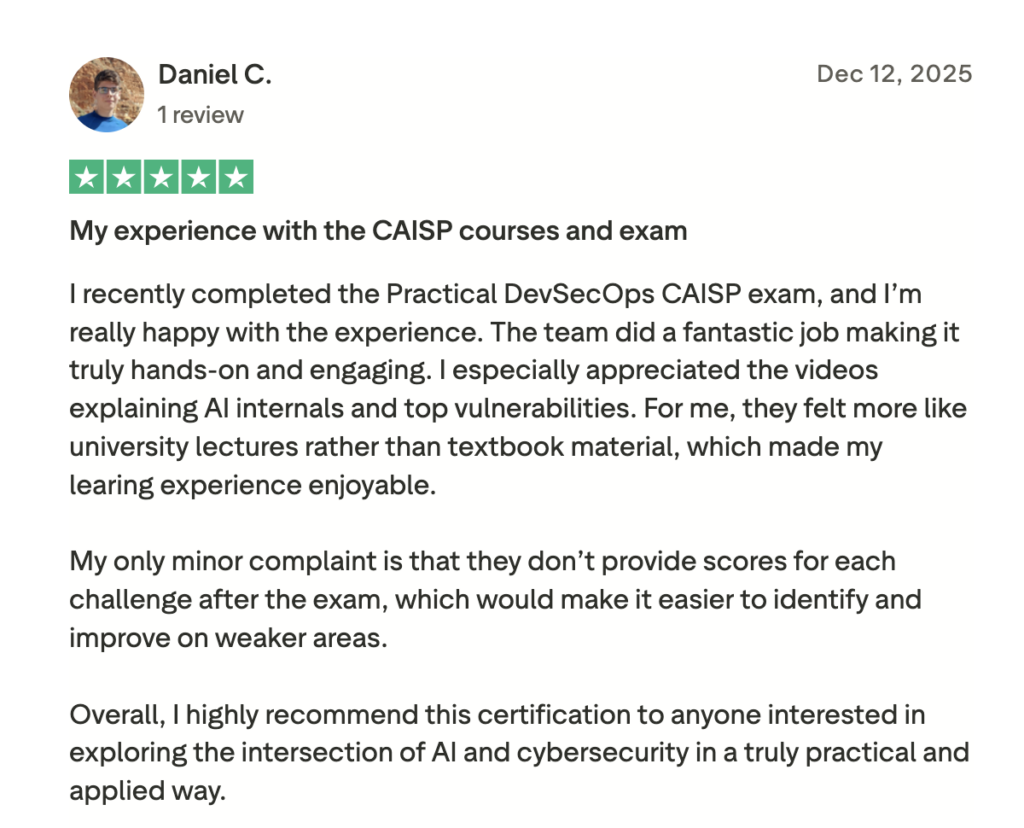
On Trustpilot, Practical DevSecOps holds a 4.8 out of 5 rating across 701 reviews. Recurring themes across the reviews include the hands on lab format, the practicality of the exam, and responsive support during the course.
 Certified AI Security Professional (CAISP)7-day free trial
Open a live AI security lab in your browser today
Real targets, real terminals, no local setup.
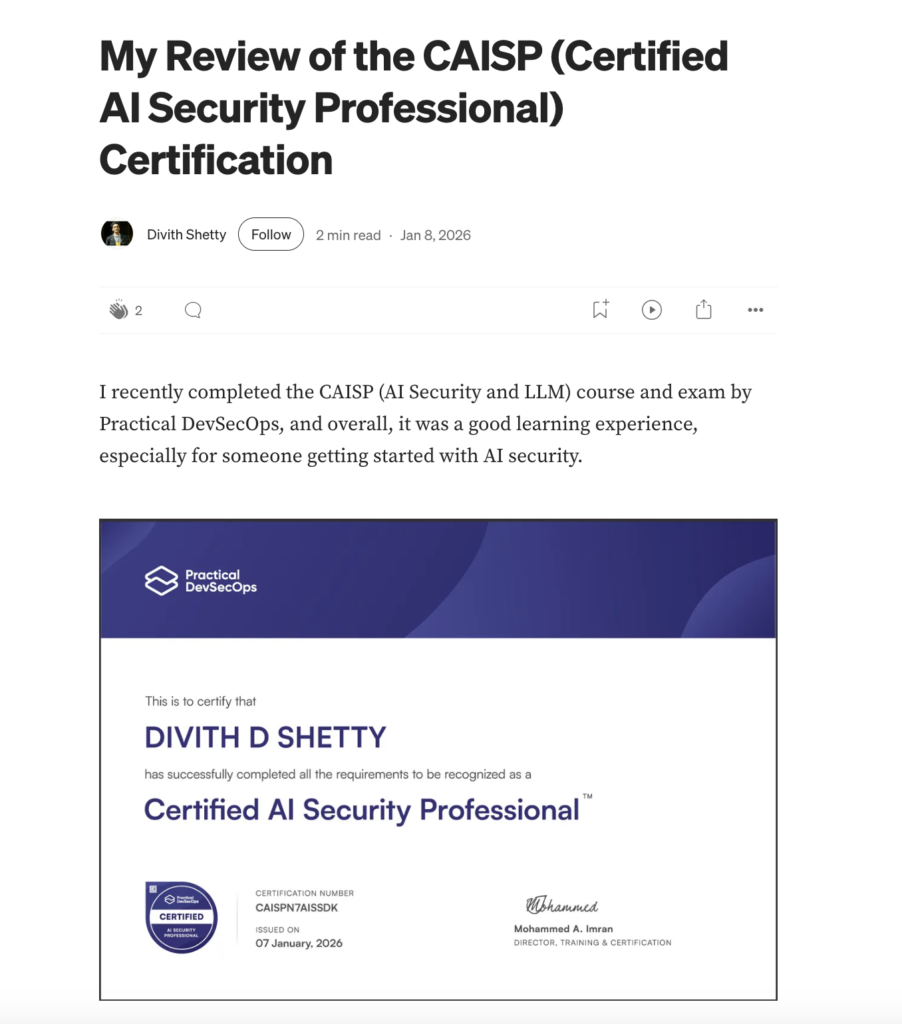
On Medium, an independent learner review published in January 2026 described the CAISP curriculum as well structured, with labs that map closely to what is actually tested. The same review noted the exam format of five challenges completed within a six hour window.
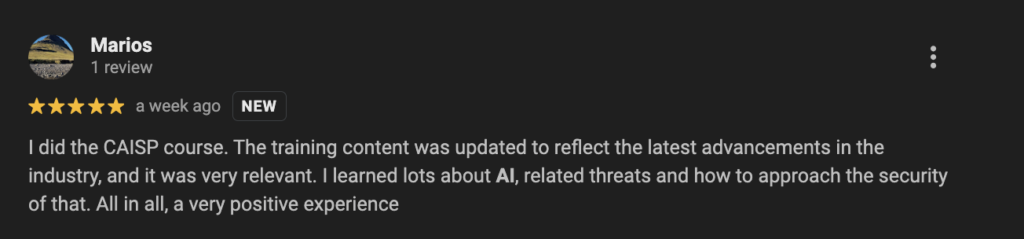
On Google Reviews, Practical DevSecOps has a searchable, independently verifiable set of ratings that readers can check for themselves rather than relying on any single platform.
The point of surfacing these is not to replace your own judgment. It is that when a certification is this new, third party review signal is one of the few objective ways to sanity check vendor claims before committing real time and money.
A few practical tips for checking any AI security certification yourself:
- Read reviews from the last six months specifically, since course content changes quickly in this space
- Look for mentions of whether labs matched the actual exam
- Pay attention to complaints about support responsiveness, since that matters most when you get stuck
- Cross-check sentiment across at least two independent platforms before trusting either one
Deep Dive: CAISP, Full Spectrum AI Security
CAISP is built for professionals who need to build, defend, and manage AI systems, not just demonstrate they can break them. The curriculum breaks down into five areas.
1. Curriculum Breadth
CAISP maps its content to two frameworks:
- OWASP LLM Top 10, covering the most common LLM specific vulnerabilities
- MITRE ATLAS, mapping adversarial tactics and techniques against AI systems
In practice, this means the course is not teaching abstract theory. It is teaching you to recognize and categorize the same threat patterns your organization’s risk register will eventually need to track, using terminology hiring managers and auditors already recognize.
2. Threat Modeling Component
The course includes hands-on work with STRIDE, adapted specifically for AI systems. You also get exposure to tooling like StrideGPT to help identify risks before a single line of code ships.
This is a pre-deployment discipline. The goal is catching design level risk in an AI feature before it becomes a production incident, which is a very different skill than finding a vulnerability after the fact.
3. AI Specific DevSecOps
This is where CAISP differentiates most from a generic security certification. It teaches:
- Software Composition Analysis (SCA) adapted for AI dependencies
- Model scanning to catch tampered or compromised model artifacts
- Defense against poisoned pipeline attacks, where a compromised dependency or model makes it into production through a normal CI/CD path
Traditional DevSecOps tooling was not built with model artifacts in mind. This section of the course fills that specific gap.
4. Supply Chain Security
You will work directly with:
- AIBOMs, or AI Bills of Materials, which document what is actually inside a deployed model
- SLSA, a framework for verifying build and provenance integrity
- Model signing, used to confirm a model has not been tampered with before deployment
This is the AI security equivalent of software supply chain hardening, which is already standard practice in mature AppSec programs.
5. Format and Accessibility
CAISP is designed to remove friction from studying. Key details:
- Training is self paced with browser based labs, so there is no time lost setting up virtual machines
- Learners get 24/7 instructor support during preparation
- The exam is a 6 hour practical covering five challenges, followed by a 24 hour window to complete and submit the report
This format is designed to mirror the pace of a real security sprint, not an artificial endurance test.
Deep Dive: OSAI, Offensive AI Red Teaming
OSAI is a deep dive into adversarial operations against AI systems. It is built for the professional AI red teamer whose primary job is simulating high level attacks.
1. Curriculum Focus
The course centers on an offensive methodology built specifically for AI environments, including:
- Reconnaissance techniques against AI specific attack surfaces
- Gaining initial access into AI systems, distinct from traditional network or application penetration testing
2. RAG and Multi Agent Exploitation
A significant part of the curriculum focuses on:
- Testing Retrieval Augmented Generation (RAG) control surfaces
- Abusing multi agent systems, where several AI components interact and can be manipulated against each other
This attack surface is specific to how modern LLM applications retrieve and act on external data. Traditional penetration testing training does not cover it.
3. Exam Format
The certifying exam is a 48-hour continuous red team engagement. It tests:
- Your ability to sustain an offensive operation over an extended period
- Your ability to report clearly on impact after the engagement ends
This is closer to a real world long form engagement than a timed lab challenge, which is exactly the point of the format.
4. Format and Accessibility
Key details on how OSAI is structured:
- Training runs through modular, self paced VM labs
- OffSec recommends 50 to 100 hours of study, spread across roughly 6 to 12 weeks
This is a heavier time investment than CAISP’s format. It is worth planning around realistically rather than optimistically, especially if you are studying around a full time job.
Head to Head: Key Differences That Matter
| Dimension | CAISP | OSAI |
| Scope | Full lifecycle: modeling, defense, pipeline, supply chain | Single discipline: offensive testing, covered in depth |
| Time investment | Fits within 60 days of self paced lab access | 50 to 100 hours over 6 to 12 weeks, plus the exam |
| Lab environment | Browser based, no setup friction | VM based, more setup but closer to a real offensive environment |
| Exam philosophy | 6 hour practical plus 24 hour report, sprint style | 48 hour continuous engagement, endurance style |
| Skill transferability | Maps to daily job tasks across multiple roles | Maps deeply to one specialization |
| Support structure | 24/7 instructor support during prep | Self paced, more independent study by design |
A few of these differences deserve a bit more context:
- Scope is the biggest structural difference. CAISP was built to cover an entire lifecycle. OSAI was built to go deep on one part of that lifecycle.
- The lab environment affects how quickly you can actually start practicing. Browser based labs mean you open a tab and start. VM based labs mean you spend time on setup first, which some learners actually prefer because it mirrors real engagement conditions.
- Exam philosophy is testing two different things entirely. CAISP’s format tests whether you can move at the pace of a real security sprint. OSAI’s format tests whether you can sustain focus and operational discipline over a long engagement.
Career Impact and Salary Considerations
AI security hiring is currently outpacing the supply of professionals who can demonstrate AI specific skills. Most security teams were built and trained for traditional infrastructure risk, not for LLMs, agents, and RAG pipelines. That gap is exactly what is driving employer demand for AI specific certification as a hiring signal.
Professionals moving from Security Engineering, AppSec, or DevSecOps into AI focused roles commonly report a 15 to 20 percent pay increase with CAISP certification. That figure should be read as a directional data point rather than a guarantee, since individual results vary with prior experience, location, and current market conditions.
Here is how each certification maps to real roles:
| Role | Best supported by |
| AI Security Engineer | CAISP |
| Lead AppSec Engineer (AI/ML) | CAISP |
| AI Risk and Compliance Consultant | CAISP |
| DevSecOps Architect | CAISP |
| AI Red Teamer / Offensive Security Specialist | OSAI |
CAISP’s defensive and governance skill set realistically supports more roles across an organization, simply because more roles need those skills. OSAI maps deeply to one specialization, which is exactly what makes it valuable for someone already committed to that path.
One important caveat: A certification alone does not guarantee a title or a raise. Experience, a demonstrable portfolio, and current market conditions all factor into hiring outcomes. A certification is a credibility signal that opens doors. It is not a substitute for the work of building real, provable skills.
Digital Badge and Credential Verification
Passing the CAISP exam issues a verified digital badge through Credly’s Acclaim platform. The badge displays validated competencies, including:
- AI Security
- DAST
- LLM Firewalls
- Prompt Injection Defense
- MITRE ATLAS
- Threat Modeling
- 15 or more additional validated skills
The badge is built for practical, everyday use:
- Add it directly to a LinkedIn profile
- Include it in an email signature
- Attach a verified link to a resume
Why this matters to recruiters specifically: anyone reviewing the badge can click through and verify the certification instantly. There is no PDF to request and no credential to explain over email. For recruiters and hiring managers moving through a high volume of candidates, an instantly verifiable badge removes friction that an unverifiable claim simply does not.
Skills You Will Walk Away With
With CAISP, you will be able to:
- Identify and block prompt injection and data leakage
- Build secure AI pipelines that catch vulnerabilities in models and dependencies
- Create AIBOMs and apply model signing to secure the AI supply chain
- Perform risk ratings and threat modeling for complex AI architectures
With OSAI, you will be able to:
- Conduct offensive testing against multi agent AI systems
- Execute post exploitation analysis in AI environments
- Translate offensive findings into defensive insights
Decision Framework: Which Should You Choose?
Choose CAISP if:
- You are a Security Engineer, Pentester, AppSec professional, Product Security professional, DevSecOps Engineer, or AI/ML Engineer
- You need to secure AI applications, manage supply chain risk, and implement real world defenses
- You want a certification that supports a broad set of roles, with a reported 15 to 20 percent salary bump
Choose OSAI if:
- You are a full time penetration tester or AI red teamer
- You want to specialize specifically in AI offensive security and exploitation
- You can commit to a 48 hour practical exam and the longer prep window that comes with it
Can you do both? Yes. Neither certification requires the other as a prerequisite. A common and reasonable path for professionals who want full spectrum AI expertise over time is:
- Start with CAISP to build a broad defensive and systems level foundation
- Follow with OSAI to specialize in offensive testing once you already understand the systems you are attacking
The reverse order works too, especially if your immediate job need is offensive focused right now.
Common Mistakes When Choosing an AI Security Certification
- Choosing based on name recognition alone, without checking whether the curriculum actually matches your day to day work
- Ignoring role fit, such as picking an offensive only certification for a defensive role, or the reverse
- Underestimating the time commitment, especially for endurance style exams like OSAI’s 48 hour engagement, against an already full job and life schedule
- Skipping independent reviews, and relying only on a certifying body’s own marketing before enrolling
- Assuming a certification replaces hands on experience, when it is really a credibility signal and a skills accelerator, not a substitute for real production work
Conclusion
The core distinction between these two certifications is not which one is better in the abstract. It is breadth plus defense versus depth plus offense.
CAISP covers the full AI security lifecycle. It is built for professionals who build, defend, and govern AI systems day to day. OSAI goes deep on one discipline, offensive AI red teaming, and is built specifically for full time offensive specialists.
For most security engineers, AppSec leads, and DevSecOps professionals moving into AI focused roles, CAISP’s broader scope and job aligned skill set make it the stronger career investment. If your role is offensive security specifically, OSAI’s specialization is worth pursuing on its own merits, either on its own or as a second credential after a defensive foundation.
Ready to build job ready AI security skills? Enroll in the Certified AI Security Professional (CAISP) course today.
Certified AI Security Professional
Secure AI systems: OWASP LLM Top 10, MITRE ATLAS & hands-on labs.

Key Takeaways
- CAISP covers full spectrum AI security, including OWASP LLM Top 10, MITRE ATLAS, STRIDE threat modeling, and AI supply chain defense.
- OSAI is a narrow offensive track built for dedicated AI red teamers, with a 48 hour exam that tests long form exploitation, not defensive implementation.
- CAISP suits security engineers, AppSec leads, and DevSecOps professionals who need to build and defend production AI systems daily
- Professionals moving into AI security roles with CAISP report a 15 to 20 percent salary increase on average.
- Both certifications can be pursued together, with CAISP as a strong defensive foundation before specializing further with OSAI
FAQs
CAISP is designed for security professionals with foundational skills. You should be comfortable with basic Linux commands and familiar with at least one scripting language like Python, Golang, or Ruby. Prior AI or machine learning experience is helpful but not required; the course starts with AI fundamentals before moving into advanced security topics.
CAISP offers 60 days of lab access with self-paced learning, and most professionals complete it within that timeframe. The OffSec AI Security Certification (OSAI) recommends 50-100 hours of study (6-12 weeks). The key difference is the exam: CAISP has a 6-hour practical exam plus 24 hours for reporting, while OSAI requires a 48-hour continuous red team engagement.
CAISP is the clear winner for Security Engineering and AppSec professionals. It covers securing AI deployment pipelines, implementing SCA and model scanning, and defending against supply chain attacks. These are skills you’ll use daily. OSAI focuses on offensive red teaming, which is valuable but less applicable to building and defending production AI systems.
Many professionals report salary increases in the 15-20% range when transitioning into AI security roles with CAISP certification. The AI security market is growing rapidly, and certified professionals are in high demand. While individual results vary based on experience and location, CAISP provides the job-ready skills that employers are actively seeking and willing to pay premium rates for.
Yes, the CAISP exam is completely online; you can take it from your home or office. The certification package includes one exam attempt. If you need to retake the exam, Practical DevSecOps offers exam retake options. The exam format (5 challenges in 6 hours plus 24-hour reporting) is designed to mirror real-world security sprint conditions, making it both practical and achievable for working professionals.
CAISP from Practical DevSecOps covers defensive and offensive AI security with structured lab exercises and a proctored exam, priced at $1,099. OSAI from OffSec focuses on offensive AI techniques with OffSec’s hands-on exam format. CAISP suits security professionals moving into AI roles. OSAI suits experienced red teamers adding AI to their toolkit.