

The rise of Large Language Models (LLMs) and autonomous agents has changed the attack surface for every organization. Security teams now face threats like prompt injection, training data poisoning, and insecure plugin designs.
To stay ahead, professionals are looking for specialized training. Two names often appear: the Certified AI Security Professional (CAISP) from Practical DevSecOps and the Advanced AI Red Teaming certification, also known as OffSec OSAI, from OffSec.
Certified AI Security Professional
Secure AI systems: OWASP LLM Top 10, MITRE ATLAS & hands-on labs.

This certification comparison breaks down the differences to help you choose the right path for your career and your organization.
Quick Summary
The Certified AI Security Professional (CAISP) is the top choice for experienced security engineers, AppSec leads, Red Teamers, and DevSecOps professionals. It covers the full lifecycle of AI security, from threat modeling and LLM vulnerabilities to pipeline defenses and supply chain hardening. The OffSec AI Security Certification (OSAI) is a specialized offensive track designed for the dedicated AI Red Teamer focused on long-form engagements and exploitation.
Side-by-Side Comparison
| Feature | CAISP (Practical DevSecOps) | OSAI (OffSec) |
| Primary Focus | Full-Spectrum AI Security & Defense | Offensive AI Red Teaming |
| Key Frameworks | OWASP LLM Top 10, MITRE ATLAS, STRIDE | Offensive Methodology, RAG Abuse |
| Training Format | Self-paced, supports browser-based labs, 24/7 instructor support | Modular, Self-Paced VM Labs |
| Exam Style | 6-hour practical + 24 hours to complete the report and submit it | 48-Hour Red Team Engagement |
| Best For | Security Pros, AppSec, AI/ML Engineers, Red Teamers and DevSecOps Engineers | Dedicated Red Teamers & Pentesters |
| Career Impact | 15-20% Salary Increase; Job-Ready Skills | Offensive Validation |
Why CAISP Is Trusted by Real Learners Across Independent Review Platforms
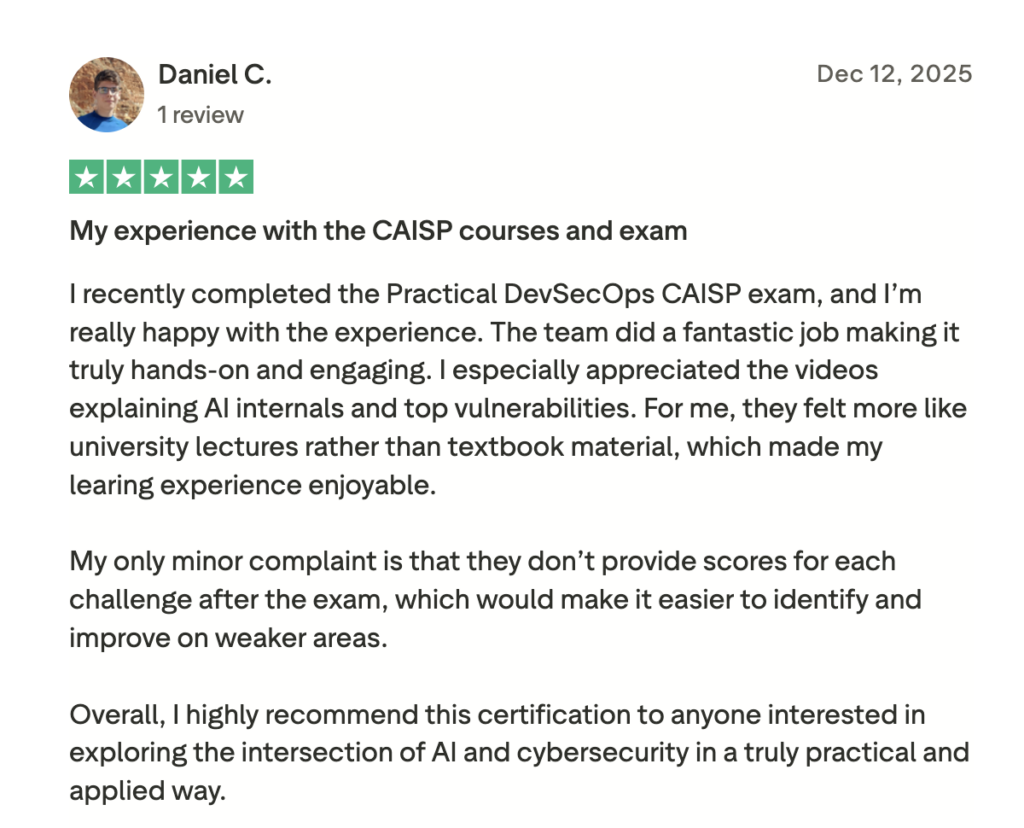
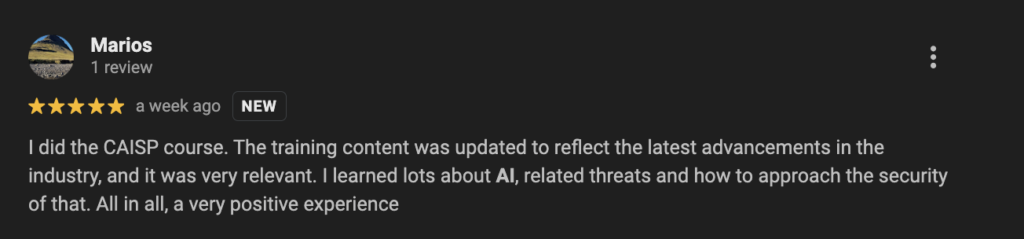
Before you decide, check what recent learners say about CAISP on sites that Practical DevSecOps doesn’t control. On Trustpilot, Practical DevSecOps is rated 4.8/5 from 701 reviews, with many reviewers calling out the hands-on labs, practical exam style, and strong support (Trustpilot).
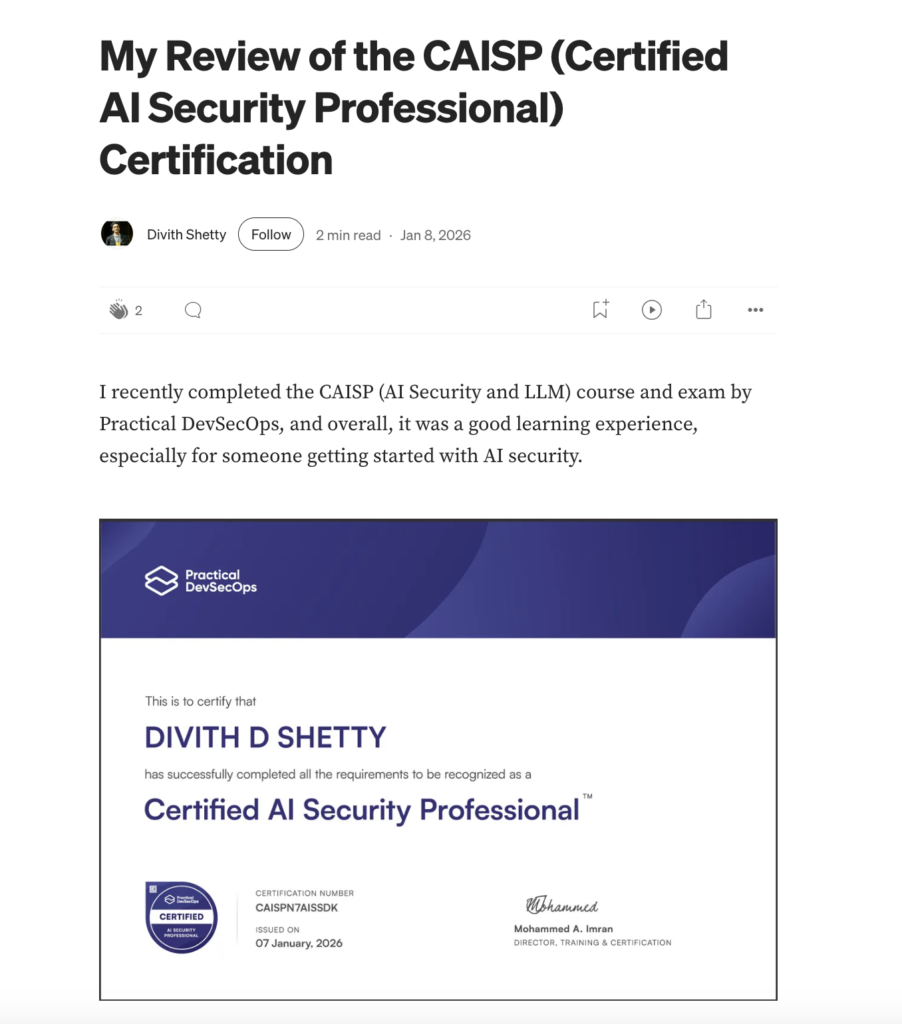
On Medium, an independent learner review (Jan 2026) describes CAISP as well-structured with labs that map closely to the exam, and an exam format of five challenges in six hours (Medium review).
You can also look up Practical DevSecOps ratings on Google Reviews via your search link for another external data point (Google reviews search).
CAISP: The Choice for Experienced Professionals
The Certified AI Security Professional (CAISP) is built for those who need to build, defend, and manage AI systems. It does not just show you how to break things; it shows you how to fix them within a modern delivery pipeline.
What makes CAISP different:
- Broad Technical Scope: You learn to handle the OWASP Top 10 for LLMs and map threats using the MITRE ATLAS matrix.
- Threat Modeling: It includes hands-on work with STRIDE and StrideGPT to identify risks before a single line of code is written.
- DevSecOps for AI: This is the only course that teaches you to secure AI pipelines using Software Composition Analysis (SCA) and model scanning to stop “poisoned pipeline” attacks.
- Supply Chain Security: You will work with AIBOMs, SLSA, and Model Signing to verify the integrity of the models and data your company uses.
Certified AI Security Professional
Secure AI systems: OWASP LLM Top 10, MITRE ATLAS & hands-on labs.
OSAI: The Offensive Specialist Path
The Advanced AI Red Teaming (OffSec OSAI) certification is a deep dive into the world of adversarial operations. It is designed for the professional AI Red Teamer whose primary job is to simulate high-level attacks against AI environments.
The OSAI curriculum is built around AI offensive security techniques:
- Exploitation: Focuses on reconnaissance and gaining initial access to AI systems.
- RAG and Agents: Testing multi-agent systems and abusing Retrieval Augmented Generation (RAG) control surfaces.
- Endurance Exam: The 48-hour exam tests your ability to maintain an offensive engagement over a long period and report on the impact.
Why Experienced Security Professionals Choose CAISP
Experienced practitioners often choose CAISP because it is immediately useful in a corporate environment. While red teaming is important, most companies need engineers who can implement defenses, audit supply chains, and threat model new features.
- Repeatable Methodologies: CAISP provides checklists and guided exercises that you can take back to your job and use immediately.
- Browser-Based Labs: There is no need to spend hours setting up complex virtual machines. You can start practicing in your browser right away.
- Balanced Approach: It covers the “how-to” of attacks like prompt injection but spends equal time on the “how-to” of mitigation and governance.
Career Growth: The 15-20% Pay Increase
The demand for AI security talent is outstripping supply. Companies are searching for people who can prove they understand the risks of LLMs and AI infrastructure.
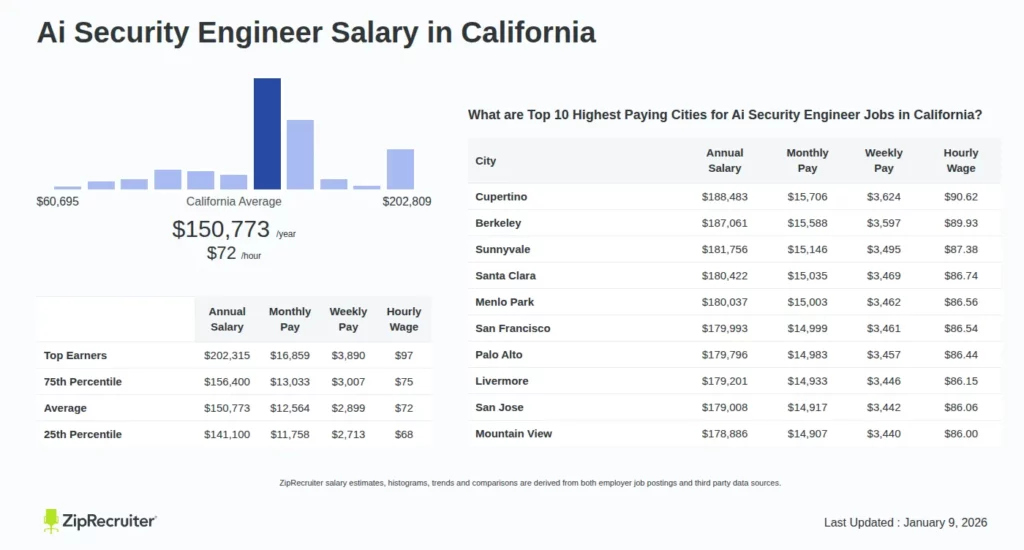
Professionals who move from Security Engineering, AppSec or DevSecOps into AI-focused roles often see a 15-20% increase in pay. Holding a CAISP certification signals to hiring managers that you have the hands-on skills to protect their AI investments. It opens doors to new roles such as:
- AI Security Engineer
- Lead AppSec Engineer (AI/ML)
- AI Risk and Compliance Consultant
- DevSecOps Architect
Prove Your Expertise with a Verified Digital Badge
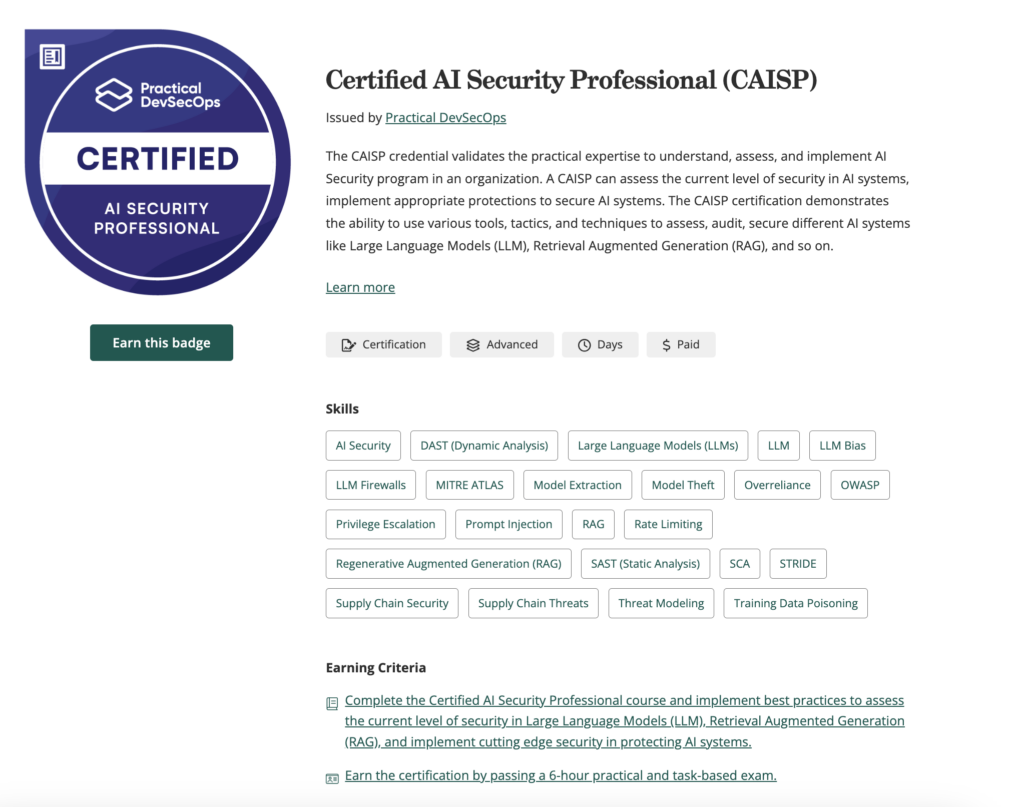
When you pass the Certified AI Security Professional (CAISP) exam, you receive a verified digital badge from Practical DevSecOps through Credly’s Acclaim platform. This badge displays your certified skills. AI Security, DAST, LLM Firewalls, Prompt Injection defense, MITRE ATLAS, Threat Modeling, and 15+ other validated competencies.
Add the badge directly to your LinkedIn profile, email signature, or resume. Hiring managers and recruiters can click through to verify your certification instantly. No PDFs to attach. No credentials to explain. The badge speaks for itself.
Certified AI Security Professional
Secure AI systems: OWASP LLM Top 10, MITRE ATLAS & hands-on labs.
Skills You Will Gain
With CAISP, you will be able to:
- Identify and block prompt injection and data leakage.
- Build secure AI pipelines that catch vulnerabilities in models and dependencies.
- Create AIBOMs and use model signing to secure the AI supply chain.
- Perform risk ratings and threat modeling for complex AI architectures.
With OSAI, you will be able to:
- Conduct offensive testing against multi-agent AI systems.
- Execute post-exploitation analysis in AI environments.
- Translate offensive findings into defensive insights.
Final Decision: Which One Is for You?
Choose CAISP if:
You are a Security Engineer, Pentester/Red Teamer, AppSec, Product Security, DevSecOps Engineer or AI/ML Engineer who needs to secure AI applications, manage supply chain risks, and implement real-world defenses. If you want a certification that helps you land a high-paying AI security role with a 15-20% salary bump, CAISP is the right path.
Pick OSAI if:
You are a full-time penetration tester or AI Red Teamer who wants to specialize in AI offensive security and exploitation and can commit to a 48-hour practical exam.
Conclusion
The AI threat landscape is moving fast. Whether you decide on the broad, defensive-heavy path of CAISP or the offensive focus of OffSec OSAI, getting certified is the best way to stay relevant. However, for those looking for the most versatile and job-aligned skills, CAISP remains the industry favorite.
Ready to lead in AI security? Enroll in the Certified AI Security Professional (CAISP) course today.
Certified AI Security Professional
Secure AI systems: OWASP LLM Top 10, MITRE ATLAS & hands-on labs.
FAQs
CAISP is designed for security professionals with foundational skills. You should be comfortable with basic Linux commands and familiar with at least one scripting language like Python, Golang, or Ruby. Prior AI or machine learning experience is helpful but not required; the course starts with AI fundamentals before moving into advanced security topics.
CAISP offers 60 days of lab access with self-paced learning, and most professionals complete it within that timeframe. The OffSec AI Security Certification (OSAI) recommends 50-100 hours of study (6-12 weeks). The key difference is the exam: CAISP has a 6-hour practical exam plus 24 hours for reporting, while OSAI requires a 48-hour continuous red team engagement.
CAISP is the clear winner for Security Engineering and AppSec professionals. It covers securing AI deployment pipelines, implementing SCA and model scanning, and defending against supply chain attacks. These are skills you’ll use daily. OSAI focuses on offensive red teaming, which is valuable but less applicable to building and defending production AI systems.
Many professionals report salary increases in the 15-20% range when transitioning into AI security roles with CAISP certification. The AI security market is growing rapidly, and certified professionals are in high demand. While individual results vary based on experience and location, CAISP provides the job-ready skills that employers are actively seeking and willing to pay premium rates for.
Yes, the CAISP exam is completely online; you can take it from your home or office. The certification package includes one exam attempt. If you need to retake the exam, Practical DevSecOps offers exam retake options. The exam format (5 challenges in 6 hours plus 24-hour reporting) is designed to mirror real-world security sprint conditions, making it both practical and achievable for working professionals.