

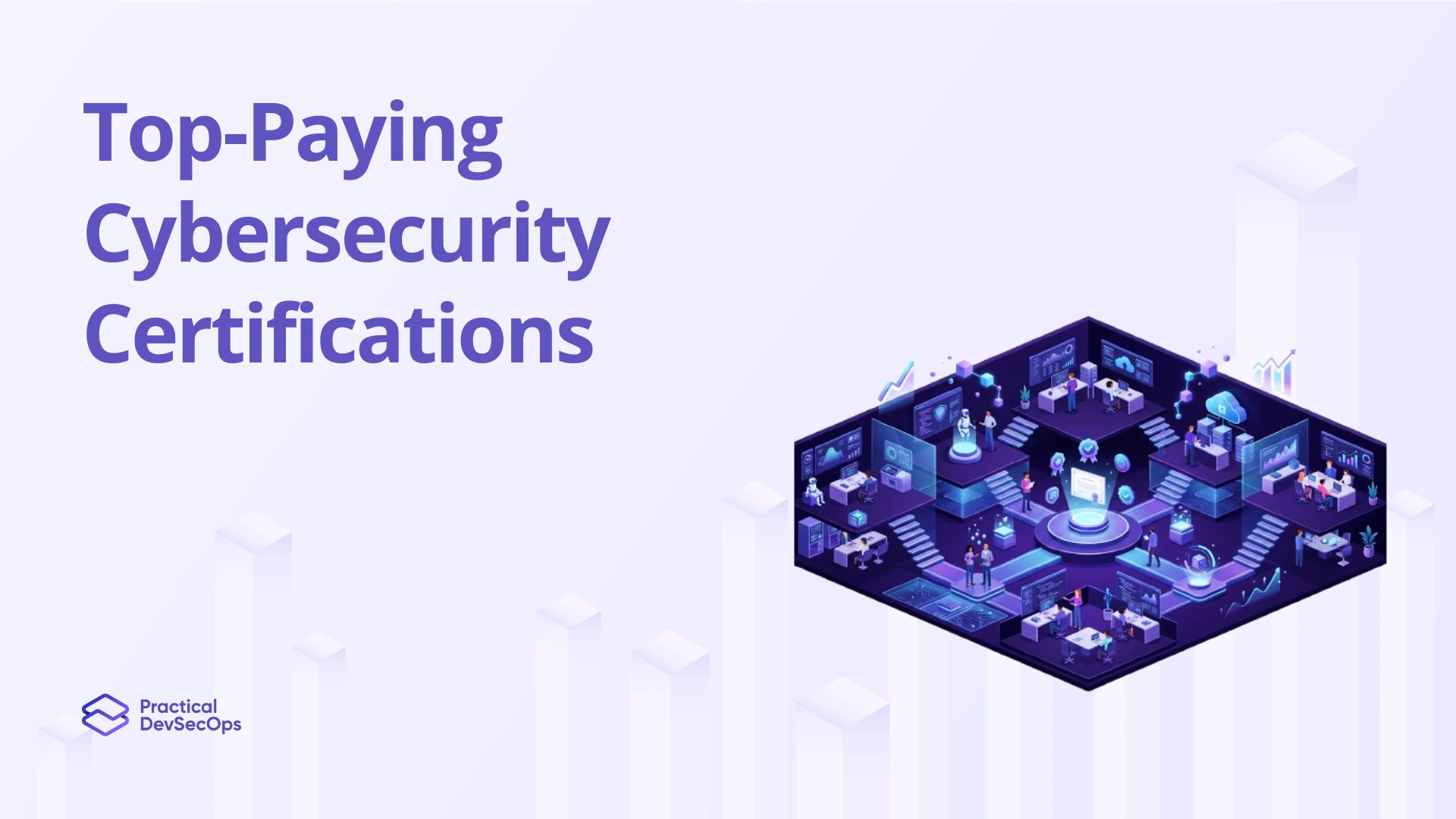
Every “highest-paying cert” list in 2026 looks the same: CISSP at the top, CISM in second, and CCSP in third. All three require 5+ years of experience before you even sit the exam. That’s the gap nobody talks about.
Experienced security engineers who want a salary bump today. Those professionals need hands-on, specialized credentials that map directly to the roles companies are actively hiring for. This guide covers the certifications that actually move compensation, including several the mainstream lists ignore entirely.
Two factors determine whether a cert adds real money to your offer: skill scarcity and direct role mapping.
CISSP pays well because it signals broad security leadership experience. But scarcity is shifting. Cloud-native security, API security, threat modeling, and agentic AI defense are now the shortage areas. Engineers who understand cloud-native security tools, container scanning, and infrastructure-as-code auditing command a $15,000–$30,000 premium over peers without those skills.
Specialized vendor-neutral certs in these areas are producing better short-term ROI than general frameworks for mid-career engineers.
Also read about OWASP MCP Top 10
The mainstream list (what everyone already knows)
CISSP holders report a US median base salary of $150,000–$185,000, CISM at $145,000–$170,000, and CCSP at $140,000–$170,000. All three share one feature: each requires 5 years of qualifying experience as a hard prerequisite.
CISSP delivers a 22% average salary boost. CISM provides an 18% increase, driven by growing demand for governance, risk, and compliance expertise.
These are legitimate numbers. They’re also downstream of the experience, not the credential. If you already have 7 years in security, CISSP will validate what you already earn. If you’re mid-career and want to move into a higher-paid specialization now, the more interesting certs are below.
The high-ROI specialized certifications most lists skip
Certified Threat Modeling Professional (CTMP)
Certified Threat Modeling Professional
Learn STRIDE, PASTA, VAST & RTMP frameworks in one certification.

Threat modeling is required by security-by-design mandates across regulated industries, and most security teams have never had formal training in it. That gap is real and it pays.
CTMP from Practical DevSecOps covers STRIDE, PASTA, LINDDUN, and attack trees across AI/ML pipelines, cloud-native systems, and CI/CD supply chains. The course runs 40+ hands-on labs. Median compensation for professionals with documented threat modeling expertise sits at $145,000+.
At $899, the cert-to-salary ratio is hard to beat for someone moving into application security or DevSecOps architecture roles.
CTMP + CASP bundle. Pairing threat modeling with API security is a specific skill stack that maps to senior application security engineer roles. You can identify design-level flaws with CTMP and validate them against the attack surface with CASP. Two related skills. One hire.
Also read about MCP Server Security Misconfigurations
Certified API Security Professional (CASP)
Certified API Security Professional
Secure REST, GraphQL & SOAP APIs: OWASP Top 10 + hands-on testing.

94% of web breaches start at the API layer. Companies pay up to $190,000 for specialists who can stop them. API Security Architects in the US average over $180,000. The supply of people who can actually do this work, not just pass a theory exam, is thin.
CASP teaches OWASP API Top 10, JWT/OAuth 2.0 workflows, injection attack detection, and broken authentication defense through hands-on labs. Priced at $899.
If your current role touches APIs at all and you don’t have a dedicated security credential, this is the fastest path to a title change.
Container Security Expert + Cloud-Native Security Expert + API Security Pro (CCSE + CCNSE + CASP bundle)
This bundle is the best value stack for engineers who work across modern infrastructure. You get container security (Docker, Kubernetes attack/defense), cloud-native security architecture, and API security in one purchase.
The market logic is simple: cloud-native security expertise consistently adds $15,000–$30,000 to salary offers, and the premium holds across every market. Container security alone is a hiring signal. All three together in one credential set makes you a specific candidate for senior cloud security engineer and platform security architect roles, not a generalist.
CCSE: $599. CCNSE: $999. CASP: $899. Bundled price on the PDSO site is significantly lower.
The new entrant: MCP security
This one won’t appear on any 2026 salary list yet because the role barely existed 18 months ago. But the numbers are already moving fast.
AI Security Engineers in 2026 run $152,000–$210,000. Lead AI Security Architects reach $200,000–$280,000 and up. Practical AI security skills, the hands-on kind, are pulling the strongest premiums. MCP security is the newest slice of that demand.
The Certified MCP Security Expert (CMCPSE) from Practical DevSecOps is the only structured cert covering agentic AI attack surfaces: tool poisoning, prompt injection via MCP servers, supply chain security, and OAuth 2.1 for AI systems.
If you’re already in application security or DevSecOps and want to position for AI security roles before the market gets crowded, this is the move. Enroll in the Certified MCP Security Expert (CMCPSE) course.
How to choose based on where you are now
| Career stage | Best cert move |
| Mid-career AppSec engineer | CTMP + CASP bundle |
| Cloud/DevOps engineer moving into security | CCSE + CCNSE + CASP bundle |
| Security engineer targeting AI security roles | CMCPSE |
| Targeting CISO or security leadership | CISSP (after 5 years’ experience) |
CISA
CISA (Certified Information Systems Auditor) from ISACA targets IT audit, governance, and compliance roles. Holders earn an average of $108,000 per year, roughly 22% more than non-certified peers. It’s a solid credential for professionals moving into GRC or internal audit tracks, though it requires 5 years of qualifying work experience before you can apply for the designation.
Comptia security+
Security+ is the standard entry point for cybersecurity careers. Certified professionals earn between $65,000 and $95,000 on average, with experienced professionals pulling $85,000–$120,000 depending on location and role. It also satisfies DoD 8140 requirements, making it a near-mandatory credential for anyone targeting federal or defense contractor positions. Strong floor cert, not a ceiling.
Certified in Risk and Information Systems Control (CRISC)
CRISC (Certified in Risk and Information Systems Control), also from ISACA, is built for professionals who sit at the intersection of IT risk and business strategy. The average base salary for CRISC holders runs around $147,000. It requires 3 years of qualifying experience and pays well in financial services, healthcare, and government. If CISM is for security program managers, CRISC is for the people who govern risk across the whole enterprise.
Also read about Best MCP Security Books 2026
Conclusion
CISSP, CISM, and CCSP will keep paying well for experienced professionals. But they’re not the only path, and they’re not the fastest path for engineers who want to move now. Threat modeling, API security, container and cloud-native security, and MCP/agentic AI security are the shortage areas in 2026. That’s where the salary premiums are growing fastest. Pick the specialization that matches your current work, get the hands-on credential, and let the offer letters follow.
Ready to position yourself for the AI security market? Enroll in the Certified MCP Security Expert (CMCPSE) courseand build the skills most security teams don’t have yet.
FAQs
For specific roles, yes. A senior threat modeling engineer or API security architect at a mid-size tech firm can match or exceed CISSP salaries without needing the 5-year prerequisite. CISSP is broader but slower to ROI.
CTMP and CASP both map to active job postings with $130,000–$190,000 salary ranges. Both are achievable within 3–4 months of focused prep. For someone already in a related role, the bump can happen at the next performance cycle or new offer.
Yes, if your current or target role involves cloud infrastructure and API security. The $15,000–$30,000 container/cloud-native salary premium is documented across multiple salary surveys. Three credentials covering the full modern stack is a specific signal to hiring managers, not just a collection of badges.
No. CTMP, CASP, CCSE, CCNSE, and CMCPSE are all vendor-neutral and designed for working security professionals. Prior security experience helps, but none require CISSP as a prerequisite.
Scarcity. The attack surface is real, the regulatory attention is increasing, and the number of people with hands-on MCP defense skills is still minimal. Early movers in new security specializations consistently earn premiums before the credential market catches up.