

MCP security is now one of the most urgent problems in AI-driven enterprise systems. The Model Context Protocol, released by Anthropic in late 2024, has gone mainstream. OpenAI, Google, Microsoft, and Block all back it. Every wired-in MCP server gives your AI agents access to databases, source code, email, cloud APIs, and production systems.
That same wiring is now the attack surface of 2026. Real CVEs, supply-chain compromises, and data exfiltration incidents prove the threat is no longer theoretical. This guide breaks down what MCP security means, what attackers are doing right now, and how to defend it.
What MCP Is and Why It Is Structurally Unsafe
MCP is an open standard built on JSON-RPC 2.0. It connects an AI host (Claude Desktop, Cursor, ChatGPT, custom agents) to MCP servers, exposing tools, resources, and prompts. One protocol replaces dozens of custom API connectors.
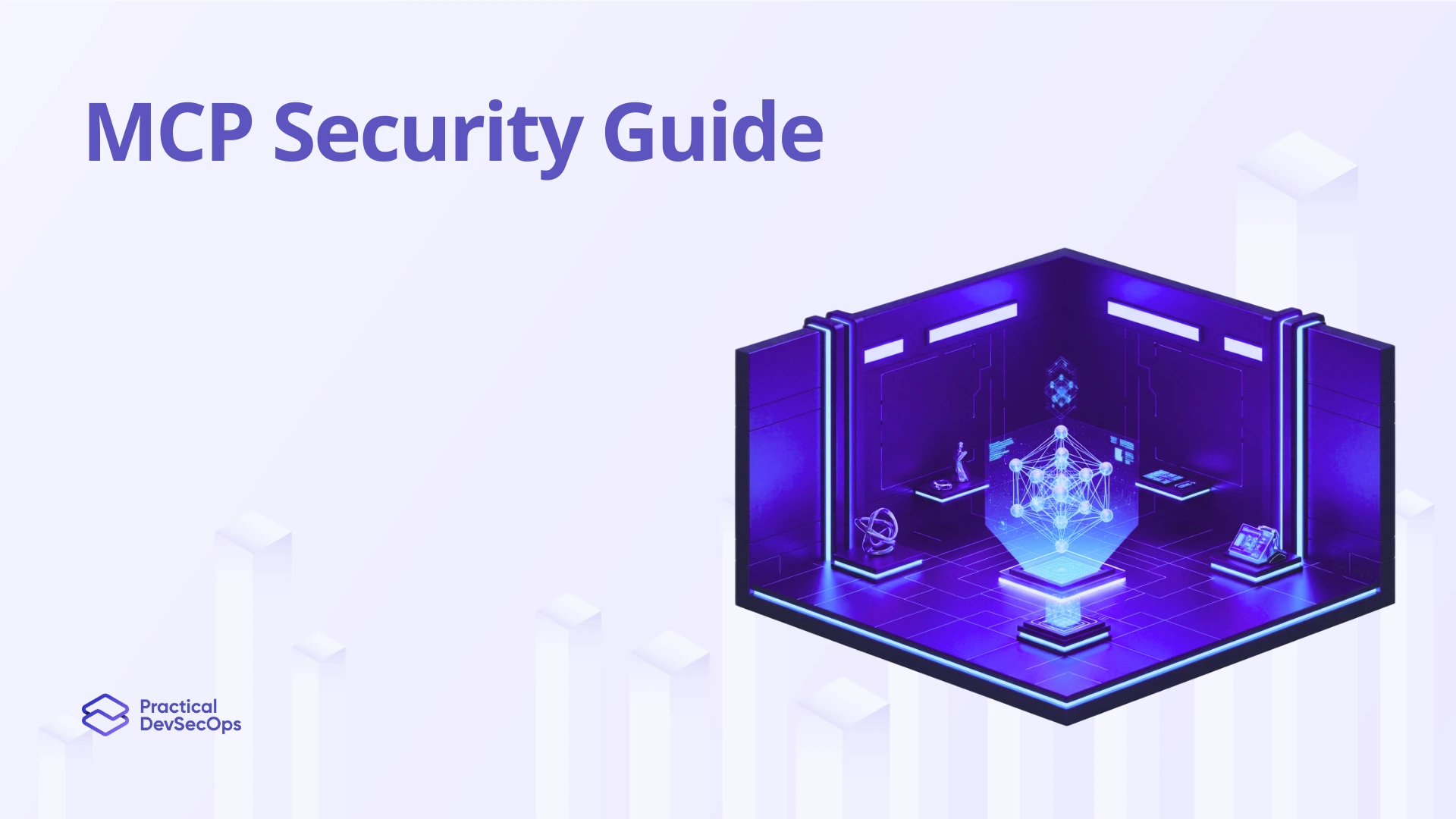
The risk is structural. The official MCP spec states the protocol “cannot enforce these security principles at the protocol level.” Translation: MCP is an empty room. You bring your own locks. Most teams do not.
The Real MCP Threats in 2026
The OWASP MCP Top 10, published in 2025, is the first proper classification of MCP risks. The threats security professionals should care about right now:
1. Prompt Injection (OWASP LLM01)
Hidden instructions inside data, tool outputs, or web pages hijack the agent. The MCP spec only “SHOULD” require a human in the loop. That word is doing too much work.
2. Tool Poisoning
Attackers plant malicious instructions inside tool descriptions and metadata. The model reads them. The user does not. The MCPTox benchmark tested 20 LLM agents against 45 real MCP servers. Most were vulnerable.
3. Rug Pulls
A clean tool you approved last week silently updates with malicious behavior this week. No re-approval. No alert.
4. Confused Deputy
The MCP server acts on behalf of a user but with broader privileges than the user has. OAuth misconfigurations make this a one-line bug.
5. Supply Chain Attacks
The first malicious MCP package hit public registries in September 2025. Typosquatting, dependency injection, and fake “official” servers are common. CVE-2025-49596 (CVSS 9.4) let attackers run arbitrary commands through unauthenticated MCP Inspector instances.
6. Excessive Scopes
Tokens with files:*, db:*, or admin:* get scraped from logs and memory. One stolen token, full blast radius.
7. Tool Shadowing
A malicious server registers a tool with the same name as a trusted one. The agent picks the wrong one. The user never notices.
8. Credential Aggregation
A single MCP server holds credentials for Slack, GitHub, Postgres, and Salesforce. Compromise it once, breach four systems.
9. Insufficient Logging
JSON-RPC 2.0 traffic does not fit traditional SIEM patterns. Most teams cannot reconstruct an MCP attack timeline.
10. Sampling Abuse
Servers asking the host model to generate text on their behalf can smuggle data out or trigger downstream actions.
The MCP Defense Playbook
Stop treating MCP servers like trusted plugins. Treat them like untrusted third-party code holding database keys.
Architecture: Run an MCP gateway
Every MCP call goes through it. The gateway enforces an allowlist of approved servers, central logging, and access control. Without it, you have shadow MCP everywhere.
Authentication: OAuth 2.1 with mandatory PKCE
Anything older is broken. Per-client consent. Strict redirect URI matching. Server-side state validation.
Authorization: Capability-level scopes
Start with the smallest scope. Step up only when the agent needs it. Reject wildcard scopes outright.
Tool governance: Per-tool allowlists
Pin tool versions. Hash the description on first approval. Re-prompt if it changes. This kills rug pulls.
Sandboxing
Run each MCP server in its own container. No network egress beyond what the tool needs. Block outbound DNS by default.
Monitoring
Log every tool invocation, parameter, and model decision. Pipe it into your SIEM with correlation IDs joining host, client, and server activity.
Human in the loop
For destructive actions (writes, deletes, sends), require user confirmation. The friction is the feature.
30-60-90 Day Rollout Plan
Days 1-30: Inventory every MCP server in production. Turn on logging. Pull hardcoded secrets out of server code. Shut down public MCP Inspector exposure.
Days 31-60: Stand up the MCP gateway. Move every approved server behind it. Apply per-client OAuth 2.1. Push allowlists.
Days 61-90: Add red-teaming. Test prompt injection, tool poisoning, and shadowing using benchmarks like MCPTox. Add SIEM rules for MCP anomalies. Write an incident response runbook.
The Skills Gap Is Real
MCP is barely twelve months old as an enterprise standard. Almost no security professionals are trained specifically on it. Most AppSec engineers know the OWASP Top 10. Almost none know the OWASP MCP Top 10. This is where careers are being built right now.
The Practical DevSecOps Certified MCP Security Expert (CMCPSE) course is built for exactly this gap. It is hands-on and lab-driven, covering MCP threat modeling, attack simulation (prompt injection, tool poisoning, rug pulls), gateway architecture, OAuth 2.1 hardening, and red-teaming MCP servers in real environments. If you secure AI systems, this is the certification to put on your resume in 2026.
Conclusion
MCP is here to stay. It is the USB-C of AI applications, and it is being wired into mission-critical systems faster than anyone is securing it. Treat every MCP server as hostile until proven otherwise. Gateway, scope, sandbox, log, and review.
Ready to get certified? Enroll in the Certified MCP Security Expert (CMCPSE) course and become the MCP security expert your team needs in 2026.
FAQs
No. The protocol does not enforce security. The host and operator own it.
No. Transport encryption does nothing against prompt injection, tool poisoning, or rug pulls.
Mostly no. Semantic attacks bypass signature-based tools.
AppSec leads, with platform engineering and AI/ML teams supporting.
Tool poisoning paired with prompt injection.