

AI is shipping faster than it can be secured. Security teams are scrambling. And most professionals are still figuring out whether they need training, a certification, or both.
Two options keep coming up: the Certified AI Security Professional (CAISP) course from Practical DevSecOps and SEC411 from SANS Institute. Same space. Very different products. One gives you a verifiable credential and a practical exam. The other gives you CPE credits and a course completion.
If you are a security professional deciding where to spend $1,000 – $2,000 and 60–90 days of effort in 2026, this breakdown will save you the research.
Certified AI Security Professional
Secure AI systems: OWASP LLM Top 10, MITRE ATLAS & hands-on labs.

Quick Comparison: CAISP vs. SEC411 at a Glance
| Feature | CAISP (Practical DevSecOps) | SEC411 (SANS Institute) |
| Price | $1,099 | $1,750 |
| Duration | Self-paced, 60-day lab access | 14 hours, 4-month access |
| Exam Format | 6-hr practical + 24-hr report | No exam included |
| CPE Credits | 36 | 14 |
| Hands-On Labs | 30+ guided exercises | 2 labs |
| Certification | Lifetime, no renewal | N/A (course only) |
| Target Audience | Security engineers, AppSec, Red Teamers, SOC operators, incident responders | Intermediate security professionals |
What is the Certified AI Security Professional (CAISP) course?
CAISP is a hands-on AI security training and certification course offered by Practical DevSecOps. A cybersecurity training company specializing in DevSecOps, AI Security, and Application Security. Practical DevSecOps has trained over 12,500+ security professionals and is trusted by Roche, Accenture, IBM, PwC, and Booz Allen Hamilton.
The curriculum covers seven chapters: LLM attacks, OWASP Top 10 for LLMs, MITRE ATLAS, AI supply chain security, threat modeling, DevSecOps for AI pipelines, and governance and compliance, including NIST RMF, ISO/IEC 42001, and the EU AI Act.
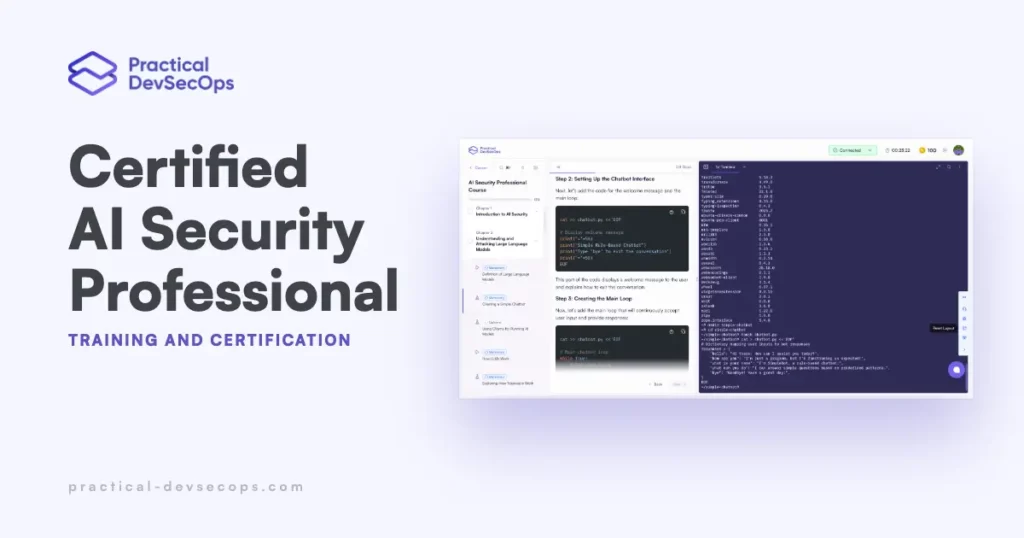
The exam is fully practical. You need to solve five real-world challenges in six hours, followed by a professional report submitted within 24 hours. No multiple choice. No shortcuts. The certification is lifetime valid with no renewal required.
What Is SEC411(AI Security Principles and Practices: GenAI and LLM Defense)?
SEC411 is a self-paced course from the SANS Institute priced at $1,750. It runs 14 hours across three sections covering the AI threat landscape, AI lifecycle security, and agentic systems. Content is updated during your four-month access window.
SEC411 awards 14 CPE credits upon completion and includes two Docker-based labs. There is no certification exam and no verifiable credential at the end. You finish the course. You get credits. That is it.
Curriculum Depth: CAISP Covers More Ground
CAISP’s seven-chapter curriculum goes significantly deeper than SEC411’s three sections. Topics exclusive to CAISP include:
- AI supply chain attacks. SBOMs, model signing, SLSA, and attestations
- Threat modeling AI systems. STRIDE, IriusRisk, and StrideGPT
- AI attacks in DevOps pipelines. Poisoned pipelines and dependency confusion
- Governance and compliance. NIST RMF, ISO/IEC 42001, and EU AI Act
SEC411 builds foundational awareness of GenAI and LLM threats. It does not cover offensive depth, supply chain security, or pipeline attacks. CAISP tests you. SEC411 trains you. That distinction matters when you are sitting across from a hiring manager.
Exam Format: Practical vs. No Exam
The Certified AI Security Professional (CAISP) course exam is task-based. Five real-world challenges in six hours, then the learner should need to send a professional-grade report within 24 hours. This mirrors what AI security specialists actually do on the job. SEC411 has no exam.
Completing the course earns CPE credits, but there is no credential to show employers. If you need to prove your real-world skills, not just list a course on a resume, CAISP is the only real option here.
Career Impact and Salary: The Numbers Behind the Certified AI Security Professional (CAISP) Course
Security professionals who earn CAISP report a 15–20% pay increase when moving into AI security roles. Certified professionals are earning between $175,689 and $213,882, compared to $110,000–$120,000 for uncertified peers.
CAISP opens doors to roles such as:
- AI Security Engineer
- Lead AppSec Engineer (AI/ML)
- AI Red Team Specialist
- DevSecOps Architect (AI)
- AI Risk and Compliance Consultant
SEC411 is a useful upskilling tool, but without an exam or verifiable credential, it carries less weight in hiring decisions. CAISP’s Credly digital badge is verifiable on LinkedIn and checked by hiring managers instantly.
Pricing and Value: More for Less
- CAISP at $1,099 includes 60-day lab access, 30+ exercises, 36 CPEs, lifetime certification, and one exam attempt
- SEC411 at $1,750 includes a 14-hour course, 2 labs, 14 CPEs, and four months of access with no exam and no certification
The Certified AI Security Professional (CAISP) course delivers more content, more labs, and a verifiable certification and costs $651 less. The value gap is not close.
Who Should Choose CAISP?
- Security engineers and AppSec professionals securing LLM-integrated applications
- Red Teamers and penetration testers adding AI attack scenarios to their work
- DevSecOps engineers securing AI pipelines end-to-end
- Professionals targeting a 15–20% salary increase by moving into AI security roles
- Anyone who needs a verifiable, lifetime credential that hiring managers can check
Who Should Choose SEC411?
- Professionals new to AI security who want a structured introduction
- SOC analysts building conceptual awareness of GenAI threats
- Those already in the SANS ecosystem looking to add AI security knowledge
- Professionals not yet ready for a practical exam
Conclusion
SEC411 is a solid introduction to AI security concepts. If you are new to the space and want structured awareness training, it does that job. But it stops there. No exam, no verifiable credential, nothing a hiring manager can check.
CAISP is a different product entirely. It is built for security professionals who want to prove skills, not just list a course. The practical exam mirrors real work. The curriculum goes deeper than any comparable offering at this price point. The Credly badge is verifiable on LinkedIn in seconds. And the certification does not expire.
The numbers back it up. CAISP-certified professionals are landing AI security roles paying between $175,689 and $213,882. That is a 15–20% jump over uncertified peers. The course costs $651 less than SEC411 and delivers significantly more.
If you are an experienced security professional targeting AI security roles in 2026, the decision is simple. SEC411 builds awareness. CAISP builds careers.
The Certified AI Security Professional (CAISP) certification is trusted by professionals at Roche, Accenture, IBM, PwC, and Booz Allen Hamilton. It pays for itself. Fast.
Certified AI Security Professional
Secure AI systems: OWASP LLM Top 10, MITRE ATLAS & hands-on labs.
FAQs
For experienced professionals seeking a verifiable credential and career growth, yes. CAISP includes a practical exam, lifetime certification, and 30+ labs at a lower price point.
No. SEC411 awards 14 CPE credits but does not include a certification exam or verifiable credential.
CAISP-certified professionals earn between $175,689 and $213,882, representing a 15–40% increase over uncertified peers.
For experienced professionals seeking a verifiable credential and career growth, yes. CAISP includes a practical exam, lifetime certification, and 30+ labs at a lower price point.
No. SEC411 awards 14 CPE credits but does not include a certification exam or verifiable credential.
CAISP-certified professionals earn between $175,689 and $213,882, representing a 15–40% increase over uncertified peers.
Basic Linux command knowledge and familiarity with Python, Golang, or Ruby. No prior AI experience required.
SEC411 has no exam, so there is no comparison there. The CAISP exam is task-based. Five real-world challenges in six hours, followed by a professional report. Independent reviewers on Medium describe it as straightforward if you complete all the labs and take notes. It is not a trick exam. It tests whether you can actually do the work.
Yes. Practical DevSecOps has trained over 12,500 security professionals and is trusted by organizations including Roche, Accenture, IBM, PwC, and Booz Allen Hamilton. The CAISP Credly badge is verifiable on LinkedIn, which means hiring managers can confirm your credential instantly without asking for paperwork.
Both. CAISP includes a dedicated chapter on AI governance and compliance covering NIST AI RMF, ISO/IEC 42001, and the EU AI Act. This makes it useful not just for security engineers but also for professionals who need to speak to compliance teams, auditors, and executive stakeholders about AI risk.
One exam attempt is included in the course price. If you do not pass, you can purchase a retake. Given that independent reviewers consistently note the exam closely mirrors the lab exercises, thorough lab completion is the most reliable preparation strategy before attempting the exam.
AI security is one of the fastest-growing specializations in cybersecurity right now, and most security teams are underprepared for it. CAISP puts you ahead of that gap.
Practically speaking, here is what changes after you earn CAISP:
Your salary goes up. Certified professionals are landing AI security roles paying between $175,689 and $213,882. That is a 15–20% jump over what most security engineers earn without an AI security credential.
Your resume stands out. The Credly digital badge is verifiable on LinkedIn. Hiring managers at companies like Roche, IBM, Accenture, PwC, and Booz Allen Hamilton can confirm your credentials in seconds.
You can do work most security professionals cannot. Securing LLM-integrated applications, running AI red team engagements, threat modeling AI systems, and locking down AI pipelines are skills hardly any people hold right now. CAISP gives you all of them.
You are compliant-ready. The EU AI Act is now in force. NIST AI RMF and ISO/IEC 42001 are being adopted across regulated industries. CAISP covers all three, which makes you valuable to legal, compliance, and risk teams, not just engineering.
The certification does not expire. No renewal fees, no re-examination cycles. You earn it once, and it stays on your record permanently.
2026 is the year organizations stop treating AI security as optional. The professionals who are already certified will be the first ones hired, promoted, and consulted when those decisions get made.